Google analytics 4

Thursday, May 12, 2011

Book 7 Augustine’s Neo-Platonism

Christianity and Neo-Platonism (7.9.13- 7.9.15) [i]

At this time Augustine began to “keep company with an ‘intellectual’ circle in which pagans and Christians mingled.”[ii] Lancel call this the ‘Millanese circle’ and it included both pagan and Christian dignitaries and philosophers. In the forefront was Manlius Theodorus, and Christian who wrote a history of philosophy and other treaties and was a fervent disciple of Plotinus.[iii]

platoAugustine also dialogued with an older priest named Simplicianus, who had read much of Plotinus and especially in the Latin translation of Marius Victorius.

Around this time Augustine notes that “a certain man grossly swollen with pride” provided him with “some books by the Platonists, translated from the Greek into Latin” (7.9.13).[iv]

Reading Plotinus helped Augustine to abandon his overly literal interpretation of divine substance. Plotinus talks about three first principles [Greek: archai] or hypostases, One (or the Good), Intellect, and Soul.[v] Bussanich notes that, “the One is the source [arche] of all beings and, as the Good, the goal [telos] of all aspirations”[vi] Plotinus believes that the nature of the One is ineffable, and that efforts to define it are doomed to fail as inadequate. At the same time it is possible to speak about it and examine its universal role in reality.[vii] Having become saturated in Neo-platonic thinking, Augustine is willing to see spiritual reality through figurative or metaphorical language rather than a crude literalism. This enabled him to see the close parallels between the philosophical presuppositions of Neo-Platonism and Christianity. Does Augustine simply accept Neo-Platonism and then project certain Christian doctrines on to it as if Plotinus believed them? There is sufficient evidence in Confessions to suggest that Augustine is well aware of the distinctions between the two systems and that ultimately he presents a contrast between the two systems.

In the next section he highlights some of the most distinctively Christian aspects. Vaught notes, “The Neo-Platonists know that the Word is the offspring of God, but they do not understand that the word became flesh and dwelt among us.”[viii] Augustine emphasizes that “The Word was made flesh and dwelt among us” (7.9.14). He also quotes from Philippians 2 noting that although Christ was “equal to God” he “emptied himself taking the form of a servant” (7.9.14). This incarnational perspective is unique to Christianity and may even contrast the ‘pride’ of the Neo-Platonists with the ‘humility’ of Christianity. The humility of God allows one to participate in true Wisdom. The truths of the Neo-Platonists are compared to the ‘gold’ the Israelites plundered from the Egyptians during the Exodus.

Neo-Platonic Mysticism (7.10.16-7.17.23)

Following the advice of Neo-Platonism Augustine attempts to attain a mystical experience. Plotinus suggested that “our awareness (sunesis) of that One is not by way of reasoned knowledge (episteme) or of intellectual perception (noesis), as with other intelligible things, but by way of a presence (parousia) superior to knowledge (Enneads VI.9.4.1-3).”[ix] Augustine attempts to purify himself and enter in to a mystical vision of God. He describes a series of visual metaphors involving light, yet this light is the presence of God. God is real but far away and his intense rays beat back his feeble gaze. The experience shifts back to an auditory experience where he hears a word in his heart. The experience was so intense there could be not possibility of doubt about its truth or reality (7.10.16).

Although this does not immediately lead to his conversion, it does give him new light on the problem of evil. Augustine argues that “things prone to destruction are good” and that “all things which suffer some harm are being deprived of some good” (7.12.18). This leads to the conclusion that everything that exists is good, and that evil cannot be a substance or being at all. All created things are good is so far as they exist, yet they can be subject to corruption. Most finite beings are not just subject to corruption but have turned away from God and become corrupt. God is the only being not subject to corruption. A thing which lacked all goodness would not exist. But evil is not only a privation of the good, but a perversity of the will twisted away from God (7.16.22).

Augustine describes another attempt to mystically ascend into God presence. He is draw towards God’s beauty but dragged away by his carnal habits (7.17.23). He attains a “tremulous glance” of That Which Is, but then is forced back through weakness. Yet he is comforted by a loving memory.

Christ as Mediator (7.18.24-7.21.27)

Finally he comes to realize his need for Christ as a mediator (7.18.24). Even so, in his pride he was not yet willing to embrace the full meaning of the incarnation. He notes that he regarded Christ “as not more than a man” (7.19.25). Christ was merely a good example of distain for earthly goods and a teacher of incomparable authority. Christ was to be preferred because of  “the outstanding excellence of his human nature and his perfect participation in wisdom” (7.19.25).

At this stage Augustine began to read the writings of the Apostle Paul. Earlier he had rejected these writings as contradictory, but now he was able to see their truth. He is particular struck by the contrast in Romans 7:22-23 between the inner desire to delight in God’s law and the other law in the bodily members “which strives against the law approved by his mind” (7.21.27).


Text © Scott McKellar 2011

All quotes in this series of blogs from Confessions are from, St. Augustine,Confessions, trans. Maria Boulding, O.S.B., The Works of Saint Augustine for the 21st Century, Ed John Rotelle, O.S.A., (New York, New City Press, 1997)


[i] John Bussanich, “Plotinus's metaphysics of the One” in The Cambridge Companion to Plotinus, Ed. Lloyd P. Gerson, (Cambridge: Cambridge Univ. Press, 1996) p. 38-65.

[ii]Lancel, St. Augustine, p. 82.

[iii] Ibid.

[iv] Most likely the Latin translation of Marius Victorius.

[v] Bussanich, p. 38.

[vi]Ibid.

[vii]Ibid.

[viii] Vaught, Encounters, p. 40.

[ix] As quoted in Bussanich, p. 41.

Wednesday, May 11, 2011

The Problem of Evil (7.3.4-7.8.12)

Adam and Eve2Augustine now affirms his belief that God created man, both body and soul, and all other corporeal things without defilement and that God is “in all respects unchangeable” (7.3.4). At the same time he acknowledges that the “cause of evil has not been clarified or disentangled” (7.3.4.). He is aware of the Church’s answer, “that the cause of evil is the free decision of our will, in consequence of which we act wrongly and suffer your righteous judgment” (7.3.5). Yet Augustine is led to question. He begins to see that the human will is at the root of his failed perception. As a Manichean he was a mere spectator who was subject to involuntary acts. Now he realizes that he is a moral agent responsible for his own actions. This leads to further questions. If God who is “Goodness” himself made him how, did Augustine derive the ability to will what is evil and refuse to do the good? Can we blame the devil? Then where did the devil come from? What is the origin of the evil will in the devil who was also created “entirely by the supremely good creator?” (7.3.5). It seems that all these answers are a dead end leading back to seeing the cause of evil in the free decision of the will.

Anticipating the later argument of Anselm, Augustine proposes that “No intelligence has ever conceived of anything better than you …” because otherwise the mind would have been able to attain something better than God himself (7.4.6). If God’s nature is totally immune to corruption then where does evil come from? In the end the root of evil will be traced back to its origins and will express itself in the possibility that evil has no being at all.[i] At this point Augustine is able to point to his faith in Christ, and in the Catholic Church. His faith is “still in many ways uninformed, wavering and at variance” with the Church, yet his mind “drank it in ever more deeply as the days passed” (7.5.7).

Touching on his past beliefs as a Manichean, Augustine gives a brief digression on why he rejects astrology. He relates how Vindicianus convinced him with a story from Firminus who knew of two people born at exactly the same moment but from completely different circumstances. They had identical horoscopes but completely different lives. One pursued a brilliant career and made lots of money, while the other was a slave. Augustine notes that the same problem occurs with twins. They are astrologically identical but suffer different fates. The example of Esau and Jacob comes to mind.

Augustine returns to the problem of evil and fin himself still in an interior turmoil, though he affirms his faith the love of God and in his Son, Jesus Christ, and “in the holy scriptures which the authority of your Catholic Church guarantees” (7.7.11). In the light of this faith gradually the darkened vision of his spirit began to improve day by day.


Text © Scott McKellar 2011

All quotes in this series of blogs from Confessions are from, St. Augustine,Confessions, trans. Maria Boulding, O.S.B., The Works of Saint Augustine for the 21st Century, Ed John Rotelle, O.S.A., (New York, New City Press, 1997)

[i] Vaught, Encounters with God in Augustine’s Confessions: Books VII-IX, p. 33.

Monday, May 9, 2011

Book 7: Encounter with Neo-Platonism

aristole

Introduction

In Book 7, Augustine encounters the writings of his contemporary Platonist philosophers[i], most likely the writings of Plotinus (c. 205-270).[ii] Plotinus is considered by modern scholars a Neo-Platonist, though there is some dispute about the use of this category. Plotinus was very knowledgeable about both Plato and Aristotle, but also the later developments in the Platonic philosophical tradition. He was able to produce an original synthesis of this material that was extremely faithful to the ‘spirit’ of Plato. He was a disciple of the philosopher, Ammonias Saccas. After his death, Plotinus’ disciple, Porphyry (c. 232-c.303) published Plotinus’ works as 54 treatises arranged in six Enneads (groups of nine), as well as his biography, The Life of Plotinus. According to his disciple, Porphyry, he born in Lycopolis, Egypt in A.D. 205 and became a philosopher at age 28.[iii] In 243 Plotinus attached himself to an expedition of the Emperor Gordian III to Persia in order to study to study Persian and Indian philosophy. When the Emperor was assassinated by his troops, Plotinus gave up these plans and moved to Rome in 245, remaining there until his death in 270 or 271.

The Nature of God (7.1.1-7.2.3)

As Augustine approaches the age of 30, he is to leave adolescence and enter “youth” (Iuventus).[iv] His philosophical thinking has become darkened by his insistence that the idea of substance must entail some sort of bodily existence. He imagined God as “something corporeal spread out in space, whether infused into the world or even diffused through the infinity outside it” (7.1.1). To deny this seem to him to predicate God’s non-existence. At the same time he believed that God must be imperishable, inviolable, and unchangeable (7.1.1). Looking back he sees how false this view is and how it contains many contradictions related to the presence of God in various sizes of objects.

Augustine moves on to recall an old argument of his friend Nebridius. What would happen, asked Nebridius, if God refused to fight against the powers of darkness? Would they have the power to injure God? Since God is inviolable, this is clearly not the case. He cannot suffer harm. This thought completely undermines the Manichean myths about an alleged fight between the powers of darkness and the powers of light which resulted in the entanglement of light and darkness in bodily existence (7.2.3). Augustine argues that either, God is incorruptible and, the Manichean myth is “shown up as untrue and to be rejected with loathing” (7.2.3) or God is corruptible and not really ‘god’ at all.


Text © Scott McKellar 2011

All quotes in this series of blogs from Confessions are from, St. Augustine, Confessions, trans. Maria Boulding, O.S.B., The Works of Saint Augustine for the 21st Century, Ed John Rotelle, O.S.A., (New York, New City Press, 1997)

[i] Mark J. Edwards “Neoplatonism” in Augustine through the Ages: An Encyclopedia, ed. Allan D. Fitzgerald, O.S.A., Grand Rapids, Eerdmans, 1999, p. 588-591. Lancel, St. Augustine, p. 82-84. Brown, Augustine, p. 79-107. Carl G. Vaught, Encounters with God in Augustine’s Confessions: Books VII-IX. (New York: SUNY Press, 2004), p. 25-66.

[ii] For these dates see “Plotinus,” and “Porphyry “ in F. L. Cross, The Oxford Dictionary of the Christian Church, 3rd rev. (New York: Oxford University Press, 2005), p. 1310, 1318.

[iii] Lloyd P. Gerson, “Introduction,” ” in The Cambridge Companion to Plotinus, Ed. Lloyd P. Gerson, (Cambridge: Cambridge Univ. Press, 1996, p. 2.

[iv] See above note 1.

Sunday, May 8, 2011

Book 6: Friends and Philosophy

Alypius (6.7.11-6.10.16)[i]

Alypius is the son of leading citizens in Augustine’s home town, and was among his students in Thagaste, and then in Carthage. Initially he is taken in by the frivolous shows of the circus in Carthage and stops his studies. Augustine offers him a correction which sets him back on the path of discipline and study. This conversion from sinful curiositas (curiosity) is the beginning of his true conversion. After studying together with Augustine, however, he first becomes a Manichean (6.7.12). He later moves to Rome to study law and becomes Assessor to the Chancellor of the Italian Treasury (6.10.16). He will later have a conversion from ambition (8.6.13) and will journey with Augustine to Baptism in Milan with Adeodatus (April 387) at the hands of Bishop Ambrose. He will return to Africa with Augustine to live a monastic life in Thagaste, and then in Hippo. In 395 he is elected bishop of Thagaste.

Nebridius (6.10.17)[ii]

Nebridius is described as a “fellow-seeker of the happy life” and “an ardent researcher into the most difficult questions” (6.10.17). Augustine says he is from a wealthy family in Carthage and he came to Milan for no other purpose than to live with him and share in his community of friends “fiercely burning zeal for truth and wisdom” (6.10.17). Nebridius was not present with Augustine at the Cassiciacum discussions before his baptism, but remained a close friend. He converted soon after Augustine and moved to Africa where he observed “perfect chastity and continence” (9.3.6). Through his example his whole household became Christian, before his death in 391.

Philosophical Perplexities and Marriage Plans (6.11.18-6.16.26)

In the thirtieth year of his life, Augustine stuck in a “muddy bog” of perplexity. The failure of Faustus and the Manicheans, the dead end of the Academics, had led him to consider anew the teachings of the Church. Augustine was still uncertain as to the true meaning of a happy life and so he put off his conversion. He considered marriage. Alypius was strongly opposed to this because it would impede their ability “to live together in carefree leisure and devote themselves to philosophy” (6.12.21). Augustine defended the possibility of a holy life in marriage and feared that he would not be able to live a life of countenance after years of living with a woman. Augustine’s desire aligned with those of his mother and a marriage was arranged for him to a young girl who was then still two years below the marriageable age (i.e. ten years old).

At the same time his group of friends began to talk about forming a community devoted to the study of philosophy, literature and the arts. The talked about a living is a somewhat secluded place and having all things in common. Those who were married, or who wished to married felt that their wives would reject the plan.

Because of the plan to enter into an arranged marriage, Augustine had to endure the loss of the woman he had been living with. He says that she was ‘ripped from his side’. Is this an allusion to the Genesis narrative? He was deeply hurt by this loss. He writes, “So deeply was she engrafted into my heart that it was left torn and wounded and trailing blood” (6.15.25). She left for Africa and vowed to never take another man, but Augustine immediately took up with another woman. Yet for all of this, his life became a misery.


Text © Scott McKellar 2011

All quotes in this series of blogs from Confessions are from, St. Augustine, Confessions, trans. Maria Boulding, O.S.B., The Works of Saint Augustine for the 21st Century, Ed John Rotelle, O.S.A., (New York, New City Press, 1997) 


[i] Peter Brown, Augustine, p. 56-7, 99-101, 469-471; Allan D. Fitzgerald, O.S.A., “Alypius,” in Augustine through the Ages: An Encyclopedia, ed. Allan D. Fitzgerald, O.S.A., Grand Rapids, Eerdmans, 1999, p. 16-17, Robert J. O'Connell, “Alypius' "Apollinarianism" at Milan (Conf. VII,25),” Revue des Études Augustiniennes (1967) 8: p. 209-210

[ii] Peter Brown, Augustine, p. 56-7, 126-129; Allan D. Fitzgerald, O.S.A., “Nebridius,” in Augustine through the Ages: An Encyclopedia, ed. Allan D. Fitzgerald, O.S.A., Grand Rapids, Eerdmans, 1999, p. 587-588.

Thursday, May 5, 2011

Ambrose Enlightens Augustine

Anthonis_van_DyckBishop Ambrose[i]  Enlightens Augustine (6.3.3-6.6.10)

Historian Serege Lancel notes that “the spiritual and emotional chronology of the Confessions . . . does not always match up with the calendar reconstructed by historians.”[ii] Bishop Ambrose bursts into the narrative of Confessions as a central figure. Clearly the focus is one Augustine’s enlightenment and not on the Bishop of Milan per se. Ambrose did not begin his career in the Church. He was a student of law and had worked his way up the ranks of government office to become the governor of the province of Milan. Lancel says he had “the promise of one of the most brilliant career of the century” in the imperial court. What prompted him to become a bishop?

One the death of bishop Auxentius, in 373, the situation in the town [of Milan] was critical; the dead prelate was of Arian faith, thus the representative of a minority that was important but on decline in the face of Catholic dominance in the city. A turbulent mob burst into the basilica where the bishops of the province held their meeting, assembled to ordain a successor to Auxentius, and both factions put pressure on an electoral body which was itself divided and irresolute. The rising had to be put down and order re-established. Rather than bring in the troops, the governor of the province chose to intervene in person; he entered the church, obtained silence, began to speak and made the people listen when he appealed for calm. The crowd then acclaimed him and in one voice demanded this unanimously respected governor for their bishop—a governor who was none other than Ambrose.[iii]

Although Ambrose was certainly a faithful Christian catechumen, he was baptized after his accession to the episcopacy and “was less familiar with the Scriptures than with Cicero and Virgil.”[iv] Ambrose took his charge very seriously and was forced to learn and teach simultaneously. He had the good fortune of excellent knowledge of both Greek and Latin, so he was able to read the Greek Fathers, especially the “Cappadocians,” Basil of Caesarea and Gregory of Nazianzius, as well as Origen and even the Jewish exegete Philo of Alexandria. From these Fathers he learned the allegorical method of interpreting the Old Testament.

Augustine met Bishop Ambrose in 385, more than ten years after he became bishop. As Augustine listened to Bishop Ambrose preach, he was convinced by the spiritual interpretation of the Old Testament that his former Manichaean objections about the Old Testament are unfounded and that what the Church says about physical and spiritual realities made perfect sense. Augustine notes, “I now began to prefer Catholic doctrine” (6.5.7). He also began to realize that many things he believed in ordinary life were accepted on the basis of authority, or on the “testimony of friends, or physicians, or various people” (6.5.7). Even the fact that he was born of a particular set of parents could not be known apart from the testimony of others. The pure philosophy of the Academics had not been able to reveal this to him. “It was because we were weak (Romans 5:6) and unable to find the truth by pure reason that we needed the authority of the sacred scriptures; and so I began to see that you would not have endowed them with such authority among all nations unless you had willed human beings to believe in you and seek you through them” (6.5.8). Augustine comments on the ability of sacred scripture to be accessible to all people, and yet to contain profound mysteries (Latin: sacramentum). He notes;

The authority of the sacred writings seemed to me all the more deserving of reverence and divine faith in that scripture was easily accessible to every reader, while guarding a mysterious dignity in its deeper sense (6.5.8).

Augustine was still mired in his journey forward by his seeking happiness in such empty pursuits as worldly “honors, wealth, and marriage” (6.6.9). This appears to be pointing to the vices of 1 John 2:16 “the desire of the flesh, and the desire of the eyes, and the arrogance of a life”[v] This comment by Augustine leads into an anecdote. He recalls that once while walking in Milan he passed a poor drunken beggar. The man was undeniably happy and filled with joy—not true joy of course. This leads him to reflect on his own unhappiness and the worldly false hopes he has just named. He reflects on this with his friends, Alypius and Nebridius which leads to a small digression on each of his friends.


Text © Scott McKellar 2011


All quotes in this series of blogs from Confessions are from, St. Augustine, Confessions, trans. Maria Boulding, O.S.B., The Works of Saint Augustine for the 21st Century, Ed John Rotelle, O.S.A., (New York, New City Press, 1997)


[i] Peter Brown, Augustine, p. 69-78; Neil McLynn, “Ambrose of Milan,” in Augustine through the Ages: An Encyclopedia, ed. Allan D. Fitzgerald, O.S.A., Grand Rapids, Eerdmans, 1999, p. 17-19. Lancel, St. Augustine, p. 65-77.

[ii] Ibid., p. 67.

[iii] Ibid., p. 67-68.

[iv] Ibid., p. 68-69.

[v] concupiscentia carnis est, et concupiscentia oculorum, et superbia vitæ.

Wednesday, May 4, 2011

Book 6: Enlightenment in Milan

Monica (6.1.1-6.2.2)[i]

St_MonicaSt. Augustine begins book six, having rejected Manichaeism but not yet having accepted Christianity. At this time his mother, Monica decide to leave Carthage and to rejoin him in Milan. Upon hearing that he had rejected Manichaeism she was overjoyed, even if he was not yet a Christian. Trusting on the vision God had given her in a dream she “redoubled her prayers and tears” to God imploring his help (6.1.1). Peter Brown describes Monica’s strengths as being, “restrained, dignified, above gossip, a firm peacemaker among her acquaintances, [and] capable, like her son, of effective sarcasm.”[ii] Monica is a constant theme in Augustine’s narrative. He will return to give more details of her life in his Book 9. In Book 6 he recounts an anecdote concerning Monica’s adherence to certain Africa pious customs such as visiting the tomb of the martyrs to make offerings of pottage, bread and wine. While Augustine makes it very clear that his mother behaved in a chaste and pious manner, these African customs had often led to drunkenness and promiscuity and “the custom resembled the cult of ancestors and was so closely kin to the superstitious practices of the pagans” (6.2.2). For this reason Bishop Ambrose had forbidden the practice in Milan and later as Bishop, Augustine will attempt to do the same in Carthage.[iii] Augustine marvels, at how graciously his mother gave up the practice, though he notes, “it seems unlikely that my mother would have yielded easily over the abolition of this custom had it been forbidden by anyone other than Ambrose, whom she highly revered” (6.2.2). Ambrose held her in mutual high regard.


Text © Scott McKellar 2011

All quotes in this series of blogs from Confessions are from, St. Augustine, Confessions, trans. Maria Boulding, O.S.B., The Works of Saint Augustine for the 21st Century, Ed John Rotelle, O.S.A., (New York, New City Press, 1997)

Image Saint Monica, Benozzo Gozzoli (fresco -1464-65)
Apsidal chapel, Sant'Agostino, San Gimignano

[i] Peter Brown, Augustine, p. 16-22; Angelo Di Berardino, O.S.A., “Monica” in Augustine through the Ages: An Encyclopedia, ed. Allan D. Fitzgerald, O.S.A., Grand Rapids, Eerdmans, 1999, p. 570-571.

[ii] Peter Brown, Augustine, p. 17.

[iii], In St. Augustine Letters 36.14.32 and 54.2.3, Augustine observes the practice of Ambrose to observe the custom of each local church with being quarrelsome. When he was in Milan he observed one custom when in Rome another.

Tuesday, May 3, 2011

Book 5: Augustine Moves to Rome

imageAbout this time an opportunity opened up for Augustine to move to Rome. Aside from a higher income and more prestige he was prompted to leave Carthage by the general bad behavior of the students there. The boorish, disruptive and even violent behavior of his students was a great frustration to him.

The move to Rome was resisted by his mother Monica. In the end, Augustine lied to her and departed secretly by ship in the night. When he arrived in Rome he became deathly ill but did not seek baptism because he still did not believe in the incarnation. He credits his eventual recover from this illness to his mother’s daily prayers for him, morning and evening.

In Rome he continued a “half-hearted” adherence to the sect of the Manicheans. In particular he enjoyed their belief that we were not personally responsible for our sins but some other nature within ourselves causes us to sin. There was no need to go to confession since he blamed “some other force” for his sins (5.10.18). This belief is linked to his belief that “evil was not only a substance, but even a bodily substance” (5.10.20).

In Rome he was attracted to a school of philosophy known as the Academics. This school recommended universal doubt about the possibility of human mind discovering truth. This lead him to be less attached to the beliefs of the Manicheans, but he says he was too lazy to seek anything else (5.10.19).

Augustine enumerates what continue to be his objections to Christianity. First he found it contemptible that God could confine himself to “appearance in human flesh” (5.10.19) and thus “could not have been born of the Virgin Mary” (5.10.20). Second he could not believe that a good God could “create any evil nature” (5.10.20) since he believed that evil was “a bodily substance” (5.10.20). He also doubted the truthfulness of the Scriptures and even that the New Testament writings “had been falsified by some unknown persons bent on interpolating the Christian faith with elements of the Jewish law” (5.11.21). Although he admits that this last charge was made without any proof.

When Augustine began to teach in Rome he soon discovered that were problems of a different sort in Rome. Although the students were better behaved in class groups of them would conspire to dodge the fees they owed to their teachers. In the midst of his frustration about this word came to him of a job offer in Milan asking for a master of rhetoric. Augustine used his Manichean contacts to obtain recommendations for the job. He was successful and proceeded to move to Milan. He notes that secretly a large part of his motivation for the move was to get away from the other Manicheans.

Text © Scott McKellar 2011


All quotes in this series of blogs from Confessions are from, St. Augustine, Confessions, trans. Maria Boulding, O.S.B., The Works of Saint Augustine for the 21st Century, Ed John Rotelle, O.S.A., (New York, New City Press, 1997)

Image from Chapel of the Choir, Church of St. Augustine.  Piazza Sant'Agostino 4, San Gimignano.  Scene 5. Augustine opens a school of rhetoric in Rome

Saturday, April 30, 2011

Confessions Book 5: Meeting Faustus

imageIn this book Augustine begins to relate his experiences during his 29th year. In particular he had begun to read certain “philosophers” (we would call them scientists today) who had studied the sun and the moon and were able to predict accurately the precise day, and hour and extant of the next solar or lunar eclipse. This research and the accuracy of their calculations convinced him that they had discovered the truth. These truths seem to contradict central aspects of the Manichean myths. The Manicheans did not seem to have adequate answers to these and other philosophical problems but they assured him that when the Manichean Bishop, Faustus arrived he would answer all Augustine’s questions. Augustine notes,

Now, I had read widely in the works of philosophers, committed a good deal to memory and still retained it, and I began to compare certain elements from my reading with the long-winded myths of the Manichees. The philosophers’ conclusions seemed to me more probable . . . (5.3.3).

Augustine notes the human pride which accompanies the philosophers who examine these heavenly phenomena. Distracted with this knowledge they fail to look for the Creator who made these calculations possible. Augustine admits,

Many true statements do they make about creation, but they do not find the Truth who is artificer or creation because they do not seek him with reverence. (5.3.5)

In fact Augustine goes on to parallel these philosophers with the corruption of the human conscience as seen in St. Paul’s letter to the Romans 1:19-20. Their unsound reason, distorts the truth into a lie, “and they worship and serve the creature instead of the creator” (5.3.5). In spite of this distortion he admits they have come to many true conclusions and compare to Mani “who had written voluminously (and incoherently) on these subjects . . . there was a wide discrepancy” (5.3.6).

Finally Bishop Faustus arrived in Rome. He was a very persuasive and eloquent speaker. It quickly became evident that in spite of Bishop Faustus’ elegant speech, he was not knowledgeable about philosophy. Augustine says he was ill-educated in the liberal arts, apart from grammar, and had read very little of Cicero or Seneca. In the end Faustus turned out to be completely incompetent for Augustine’s purposes.

This created a crisis in Augustine’s belief because it was obvious that Mani was ignorant of these matters and yet “still had the effrontery to teach them” (5.5.8). To make matters worse Mani claimed to be speaking through the Holy Spirit, with his full authority.  Augustine realizes that this was sacrilegious because Mani passed off “his erroneous opinions as those of a divine person—himself no less” (5.5.8).  Although Augustine did not immediately leave the company of the Manicheans his enthusiasm for their beliefs was waning.

Text © Scott McKellar 2011


All quotes in this series of blogs from Confessions are from, St. Augustine, Confessions, trans. Maria Boulding, O.S.B., The Works of Saint Augustine for the 21st Century, Ed John Rotelle, O.S.A., (New York, New City Press, 1997)

Image from Chapel of the Choir, Church of St. Augustine.  Piazza Sant'Agostino 4, San Gimignano. Scene 4. After meeting Faustus of Mileve, Augustine decides depart for Ostia

Book 4: What is Beauty?

Roma-Jan-05-013Augustine recounts his early thoughts on the nature of beauty. He notes that he had written several books on the topic which he has now lost, though he seems quite familiar with their content. He theorizes that beauty has two aspects. First there is the idea that some objects have an inherent quality, ‘beauty’ which we recognize as intrinsic. We also recognize a second aspect; some things are beautiful because of their harmonious relation or adaption to other things.

Augustine begins to muse about a certain orator to whom he dedicated his work on beauty. Is the love of an orator different than the admiration of an actor? Can we love traits in someone that we wouldn’t wish to have for ourselves? He notes that someone can love a horse but not desire to change places with it (4.14.22). He asks, “Do I love in one man what I would hate to be myself, when I too am a man?” (4.14.22). Augustine analyses the problem philosophically and drives beneath the unity of the species ‘man’. An individual has hidden depths affections and ‘movements of the heart’ that are known only to the Lord. He concludes that our nature as individuals depends more on the will than on the intelligible structures we exemplify.[i]

Following the intuitions of Cicero, Augustine observed the unity found in virtue and the fragmentation of human life seen in the vices. Initially he thought that the disunity was caused by an indefinable substance of evil but looking back from the present the he notes that “evil is no substance at all” (4.15.24). Later he will understand that evil is not a thing but the absence of the good.[ii] As we shall see in Book 5, Augustine used the idea of ‘evil as a substance’ to avoid personal responsibility for his actions. Augustine thought that at this point that the mind or rational soul was the supreme good (4.15.24).

Augustine interrupts the flow of his narrative with yet another anecdote, this time from seven years before he writes his first book. At the age of twenty he reads a Latin translation of Aristotle’s Categories. Again he highlights a mistake that he fell into as he tried to understand God as an instance of the categories rather than as identical with the ‘transcendentals’ (4.16.29).[iii] He will later correct this mistake in Book 7.

Plato had argued that the sensible world is a reflection or shadow of ideas which transcend the sensible realm. Chief among these transcendental properties are the one, the true and the good. Aristotle agreed with these transcendental properties but saw them not manifest in ideas but in the forms of actual things. One significant difference between Plato and Aristotle is that Plato indirectly also includes beauty as a transcendental property. Plato “argues in the Lysis and Timeaus that whatever is good (Greek: agathon) is also beautiful (Greek: kalon), and in the Republic that everything that exists participates in the good.”[iv] Augustine’s error was to attempt to see God as mere category rather than as a transcendental property. Jacque Maritain describes transcendentals as “concepts which surpass all limits of kind or category and will not suffer themselves to be confined in any class, because they absorb everything and are to be found everywhere.”[v] Ultimately Augustine is left awash in his own pride. He compares himself to the Prodigal son, who, “left you and set out for a distant land to squander it there on the quest for meretricious[vi] gratifications” (4.16.30). He concludes his prayer in this book,

We need not fear to find no home again

Because we have fallen away for it:

While we are absent our home falls not to ruins,

For our home is your eternity (4.16.31).

Text © Scott McKellar 2011


[i] Ibid., p. 108. Vaught notes that this is a development in thinking by Augustine which moved beyond common the Neo-Platonist thinking of Plotinus.

[ii] For a defense of Augustine’s views on evil against the objections of modern philosophers see Donald A. Cress, “A Defense of Augustine’s Privation Account of Evil,” Augustinian Studies (1989)20: 109 – 127.

[iii] Daniel Gallagher, “The Platonic-Aristotelian Hybridity of Aquinas’s Aesthetic Theory”, Hortulus: The Online Graduate Journal of Medieval Studies Vol. 2, No. 1, 2006, p. 2-15. http://hortulus.net/journal/20061Gallagher.pdf Accessed 4/23/2011.

[iv] Ibid. p. 2.

[v] Jacques Maritain, Art and Scholasticism, trans. J. F. Scanlan (New York: Scribner, 1930), p. 30. As quoted in Gallagher.

[vi] “meretricious: of or relating to a prostitute : having the nature of prostitution” http://www.merriam-webster.com/dictionary/meretricious

Friday, April 29, 2011

A Pope for All Ages

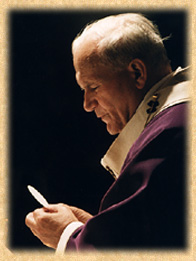
A we approach the Beatification of Pope John Paul II I think we are all struck with the shear magnitude of his accomplishments.  The Vatican Website lists the statistics for his life.  John Paul II made 104 trips abroad and visited 129 unique countries.  He visited 617 cites, and  logged over 1,000,000 miles of travel during his 26 year long pontificate.  He wrote 14 major Encyclicals, 14 Apostolic Exhortations, 14 Apostolic Constitutions, and 45 Apostolic Letters.  He also performed 1338 beatification ceremonies and 482 canonizations.  It seems everyone wants to claim him, he is A Pope for Workers; The Pilgrim Pope ; The Youth Pope ; The Feminist Pope ; The Pope for Catholic-Jewish Relations;  The Champion of the Poor;  The Pope for East-West Relations; and Pope  of Diplomacy. Fearless in hope and love, the Pope who changed and saved lives.
Pope John Paul II, Pray for us!

Book 4: Anecdotes from Augustine’s Life

In Book 4, Augustine tells us that he lived with a girl whom he does not name. The relationship was for pleasure and not for the purpose of marriage and family though he acknowledges that he was faithful to her. Later in Book 6 we will glimpse the deeper feeling he felt for this woman (6.15.25). Based on his discussion of his son Adeodatus in 10.6.14 the chronology of these nine years does not appear to be clear. It is likely that he had already taken this partner earlier (cf. 2.2.4).

Augustine relates a number of anecdotes from his life. A sorcerer tries to have Augustine engage his services in order to win a poetry contest through his occult arts and Augustine refuses. On the other hand, Augustine is greatly attracted to astrology. Looking back he sees how wrong minded this is and how even if astrology were to seem correct in its predictions this could be due to chance which he compares to the practice of randomly opening a book and happening upon a passage that appears to give a hidden message.

As the Catechism reminds us all forms of divination are grave sins against the first commandment;

All forms of divination are to be rejected: recourse to Satan or demons, conjuring up the dead or other practices falsely supposed to "unveil" the future. Consulting horoscopes, astrology, palm reading, interpretation of omens and lots, the phenomena of clairvoyance, and recourse to mediums all conceal a desire for power over time, history, and, in the last analysis, other human beings, as well as a wish to conciliate hidden powers. They contradict the honor, respect, and loving fear that we owe to God alone. (CCC 2116)

In this book Augustine also relates the painful experience of the death of a friend in Thagaste. One of the overall themes of Confessions is that of ‘friendship’ both in its positive and negative aspects. Augustine clarifies that “friendship is genuine only when you bind fast together people who cleave to you [God] through the charity poured abroad in our hearts by the Holy Spirit” (4.4.7). In this anecdote, he discusses a deep but purely human friendship. Meeting a childhood friend, Augustine leads him into Manichaeism and together they experience a friendship ‘sweeter than any sweetness’ (4.4.7). After only a year of being friends, the young man becomes fatally ill with a fever and is baptized. To Augustine’s surprise when his friend recovers temporarily he completely rejects Manichaeism. Augustine describes the anguish of their parting but comes to realize that his misery is due to his mind being chained by friendship to mortal things (4.6.11). “Woe to the madness which thinks to cherish human beings as though more than human!” (4.7.12). His intense grief over this loss, lead him to leave Thagaste and his memories there and to move to Carthage. In Carthage he notes that “what restored and re-created me above all was the consolation of other friends” (4.8.13) and allowing his mind to be distracted by their pleasant company.

This distraction is not truly a cure for his soul. Confronted with the death of a friend, the ‘god’ of Manichaeism is not able to bring rest to his soul. He is unable to live with his grief or to flee from it though he does flee to Carthage. The ‘re-creating’ he speaks of above is related to what he says about time. He writes;

Time does not stand still, nor are the rolling seasons useless to us, for they all work wonders in our minds. They came and went for day to day, and by their coming and going implanted in me other hopes and other memories. (4.8.13)

Time “becomes a principle of association that collects and disperses ideas and memories into the unity of the present moment”[i] The ideas and memories from earlier times are juxtaposed by time to rearrange their order and significance. Recollection is possible because time is linear but it is also discontinuous and reconstruction is necessary. The key to reconstruction or transformation is learning to love all things in God. Augustine writes;

If sensuous beauty delights you, praise God for the beauty of corporeal things, and channel the love you feel for them onto their Maker (4.12.18).

This is not a naive denial of the continued power of concupiscence after our conversion. Augustine notes, “Why follow your flesh, perverted soul? Rather let it follow you, once you are converted” (4.11.17). This is not to imply that once we are converted we effortlessly return to the state of original innocence experienced by our first parents in the garden. Augustine continues,

Return to your heart, then, you wrongdoers, and hold fast to him who made you. Stand with him and you will stand firm, rest in him and you will find peace. Where are you going, along your rough paths? (4.12.18).

We must seek Christ, the bridegroom, who has withdrawn from our sight, “so that we might return to our own hearts and find him there” (2.12.19). This interior transformation allows us to bring Christ into the world carry others off to God, because we “burn with the fire of charity” as we speak in the Spirit.


Text © Scott McKellar 2011

[i] Vaught, Journey, p. 98.

Thursday, April 28, 2011

Book 4: Augustine the Manichean

Manicheans wiki commonsIn book 4, Augustine begins by describing his floundering in the Beliefs of the Manichaean sect for nine long years (from his nineteenth to his twenty-ninth year). Vaught notes the movement in Books 2-4 from stealing, to loving, then finally to deceiving. Augustine is deceived and he deceives others.

The founder of Manichaeism is Mani who was born in Babylonia under Persian rule in 217. Mani’s personal history was written by his enemies and contains often contradictory unreliable accounts.[i] In modern time several manuscript collections of Manichaean writings have been discovered in Northwest China (Turkestan) and Egypt.

The beliefs of the Manichaean appear to fit within the broad category of Jewish Christian heresy of Gnosticism.[ii] As we noted above in the introduction, Manichaeism was particularly concerned with the problem of the existence of evil. Where did evil come from? Did God create evil? These questions were answered by proposing a radical dualism between the realm of light, or God and the realm of darkness or Satan. According to the Manichaean doctrine, Adam and Eve are actually the progeny of male and female demons. The first human parents are not the creation of God but resulted from Satan’s evil initiative. Particles of the Kingdom of Light were trapped in the visible world. God countered this tactic of the devil by sending Jesus from the realm of light to reveal divine knowledge (Greek, gnosis) to Adam and Eve.

In Augustine’s time the Manichaean religion had spread to Rome and Carthage and across North Africa. In practical terms the adherents of this faith considered themselves Christians. They believed that the present visible world was a mixture of light and dark elements. God, “the Father of Greatness” set up the sun and moon as collector stations for light to pass back to the realm of light. Adam and Eve were created as the progeny of demons to counter the Sun and moon and keep the light trapped in the material world principally by generating offspring. In turn God countered this move by sending Jesus from the light-realm to reveal divine knowledge (gnosis) to Adam and Eve. Coyle notes that this was not the Jesus of orthodox Christianity, “for Manicheism seems to propose several entities called Jesus” yet none of them was a savior except as the bearer of saving knowledge. Further since they believed matter was evil, the “true” Jesus could not have been born of Mary.[iii]

The followers of the Manichaean religion tried to help the world through the agency of its members who were divided into the Elect (who were generally Manichaean presbyters, bishops, and deacons) and the auditors or hearers who included both men and women. The ultimate goal was the release of all light from matter through the agency of the Elect. The Elect carried out this task through digestion. They practiced a rigorous asceticism eating no meat and consuming certain grains, vegetables and fruits thought to contain light. Once enough light was release and great fire would erupt and complete the process of separation of light and darkness. The Elect followed a rigorous moral and ascetical code. They were not permitted to kill any living thing, including harvesting food (others had to do this for them) and they observed frequent prayer (seven times per day) and fasting. The Elect were perpetual wanders owning nothing and depending on the Hearers for their care. The Hearers lived a less restrictive life with fewer prayers and fasts and were allowed to marry (though procreation was discouraged).

Text © Scott McKellar 2011


[i] Coyle, “Mani, Manicheism,” in Augustine through the Ages, p. 520.

[ii] The Standard work on Gnosticism is Kurt Rudolph, Gnosis: the Nature and History of Gnosticism, trans. Robert McLachlan Wilson (San Francisco: Harper, 1987) based on expanded revised German ed. (1980). Two other important works which argue persuasively that Gnosticism is a post-Christian phenomenon deserve mention. Edwin M. Yamauchi, Pre-Christian Gnosticism: A survey of the Proposed Evidences, 2nd ed., (Eugene, Wipf and Stock, 1983) and Simone Pétrement, A Separate God: The Christian Origins of Gnosticism, trans. Carol Harrison (San Francisco: Harper, 1984).

[iii] Ibid. p. 522.

Monday, April 25, 2011

Book 3: Student Years at Carthage

st augustine detailArriving at the great capital of Africa, Carthage, Augustine says that he was “In love with loving” not that he was in love with anything but that he was “casting about for something to love” (3.1.1). Vaught comments, “If the love of stealing is a love of nothing, the love of loving is love for the deeper nothingness from which stealing for its own sake emerges.”[i] This vacant idea of loving is linked to sexual promiscuity, where the desire to love and be loved is sweeter if he can enjoy a lover’s body. His desire to experience strong emotions is fed by being a spectator at the theatrical shows featured Carthage. He enjoyed being moved to tears by the theatrical tragedies (3.4).

In Carthage Augustine became a master in the School of Rhetoric with a goal of working in the law courts (3.6). He associated with a group of friends who called themselves the ‘wreckers’[ii] but distanced himself from their activities of bullying sensitive freshmen.

Studying treatises on elegance, he discovered a work by Cicero, called Hortensius which contained an introduction to philosophy. He was “won over not by its style but by what it had to say” that is by the notion of philosophy as the love of wisdom. He notes, “I was aroused and kindled and set on fire to love and seek . . . wisdom itself” (3.8).

As mentioned earlier in the introduction, Augustine’s interest in philosophy led him to read the Sacred Scriptures. He was immediately put off with the poor Latin translation that existed at the time (cf. Sermon 51.6). He was looking for the elegant prose of Cicero and found instead what appeared to be barbarous and unappealing. He blames his lack of appreciation on pride.

About this same time he began to listen to a group of Manichaean’s who “subtly maneuvered” him into accepting their views. The raised questions about the origin of evil and criticized anthropomorphic descriptions of God, and the moral practices of the Old Testament saints (3.7.12). The Manichaean’s were confused about the existence of absolute morals found in God’s eternal law rather than codes based on human custom and did not understand the idea of progressive revelation (3.13-3.8.15). God had slowly revealed his nature in the Old Testament. Looking back Augustine called absurd the belief of the Manichaean’s that if one of their elect ate a fig and belched or groaned in prayer “he would spew out angles, or even particles of God” (3.9.17).

Augustine’s deception led his mother Monica to grieve for him with many tears and to implore God for help. As she beseeched God, she had a vision or dream which Augustine recounts. He notes, “She dreamed that she was standing on some kind of wooden ruler, and she saw a young man of radiant aspect coming toward her” (3.11.19). The young man was happy while she was sad. He asked her why she was sorrowful, and she said because of his ruin. He admonished her to take note that, “where she stood, there also did I” (3.11.19). She took courage in the belief that Augustine would eventually be a Christian, though for nine more years Augustine “floundered in the mud of the deep and the darkness of deception” (3.20).

Text © Scott McKellar 2011


[i] Vaught, Journey, p. 69.

[ii] “Eversores, literarily those who upset, overthrow, sack the city” Boulding, WSA I/1, p. 78 n. 12.

Book 2: Adolescence

AdamAndEveIn book 2 Augustine moves on to discuss the sins of the flesh he committed during adolescence. He notes that he only delighted in loving and being loved but without proper restraint. His erupting puberty sent him into a “fog of lust” and he “floundered in the tumultuous sea” of his fornications (2.2.2). He asks, “Who was there to alleviate my distress?” Why did his parents not encourage him to marry? Could he not have been content to use his sexuality to procreate children? Yet he recognizes that he would not have found peace in marriage, since he feels called to the celibate life. Yet at the age of sixteen his family tolerated him forming a relationship with a concubine, rather than a marriage (2.4).

In that same year he was forced to return to his native Madaura, while his father saved up to send him to Carthage. Although he recounts that his mother warned him to keep clear of fornication and adultery, he was reckless and did not head her advice. Driven on by peer pressure he recounts that he even pretended to obscenities that he had not committed (2.7) in order to appear a rascal to his adolescent friends.

In Augustine’s mind one particular episode in the adolescent life stands out, and that is the robbing of the pear tree.[i] Augustine reminisces about the thief of pears from a tree near his home. With a group of boys he stole the fruit simply to enjoy stealing. He notes that its fruit was “not enticing, either in appearance of flavor” (1.4.9). The boys took enormous quantities of fruit and ate very little, the rest they thru to the pigs. The wasteful act was done primarily for the sinful pleasure of doing what was forbidden.

Does Augustine intend to highlight this episode because of its parallel to eating the fruit of the Tree of the knowledge of Good and Evil in the Genesis account of the Fall? Is there a contrast with his later conversion under the Fig tree in the Garden in 8.12.28? Both seem quite likely but why specifically a pear tree? Shanzer has proposed that the pear may also be a verbal allusion to the pagan Roman literary tradition.[ii] The common Roman understanding of pears is that they are ordinary and cheap. There are apparent parallels between this story and a parable in Horace about an unwanted gift of pears which also involves boys and pigs. Shanzer notes,

Horace explored the graceless and useless gift with a rustic fable that highlighted the behaviour of the giver. Augustine took a criminal and meaningless theft and explored it from the point of view, not of the giver or receiver, but of the taker. In both cases boys and pigs get pears, in neither does either derive any good from the fruit. The stories are two different reflections of the similar facts.[iii]

An even stronger reaction might come from a Manichaean background. Manichaean mythology believed that trees sprang up from the semen of demons and there fruit contained the particles that escaped from the Kingdom of Light. A Manichaean would never intentionally pick fruit and if they did they would ask one of the Manichaean elect to ingest it to release its hidden light.[iv]

While all of this must surely have been in his mind, the focus appears to be on the Genesis parallel and the mystery of sin. Augustine makes it clear he had no ethical reason to steal the fruit. It was stolen purely for the pleasure of the act itself. He also makes clear seven times in (2.8.16-2.9.17) that he would never have stolen the fruit alone. Does the theme of negative peer pressure, or the danger of bad friendships, parallel the situation of Adam and Eve? Does it parallel the ‘stolen’ pleasure of sexual concupiscence?

The next section of his text talks about how the beautiful form of physical things attracts our eyes (2.5.10). Augustine then discusses friendship which draws human beings together, but notes that “sin gains entrance through these and similar good things when we turn to them with immoderate desire” (2.5.10). He then moves on to enumerate a list of vices which lurk in “counterfeit beauty” (2.13); pride, ambition, flirtatiousness, curiosity, ignorance and stupidity, sloth, extravagance, avarice, envy, anger, timidity, and sadness (2.13). He concludes that, “a soul that turns away from you therefore lapses into fornication” (2.14). He asks, “Is there anyone who can take stock of his own weakness and still dare to credit his chastity and innocence to his own efforts?” (2.7.15). Although this incident of stealing fruit is real, it stands as a metaphor for his own meaningless stolen pleasures which are a part of the corruption of the bad company he kept.

Text © Scott McKellar 2011


[i]Danuta Shanzer, “Pears before Swine: Augustine, Confessions 2.4.9” Revue des Études Augustiniennes, 42 (1996), 45-55. Augustine appears to have mixed thoughts from both the classical author Horace and the Bible in Gen 3.

[ii] Ibid., p. 50.

[iii] Ibid., p. 52-53.

[iv] Vaught, Journey, p. 55.

Friday, April 22, 2011

Infancy and Childhood (Confessions 1.6.7-1.20.31)

st augustine detailIn discussing his infancy Augustine is forced to talk about what he in a sense cannot know or understand because he cannot remember and as an infant he lacked the cognitive tools to assess his environment. This beginning highlights a profound place of humility that represents our common condition as humans. We all begin in a state of original innocence. Although we cannot examine this state through recollection we can explore it by inference through the observation of other infants. St. Augustine is not attempting to engage in scientific enquiry or to develop a theory of cognition. His focus is on the will and the practical context of communal interaction. Carl Vaught notes, “The infant’s struggles to express its desires reflect a fundamental opposition between positive and negative elements in its nature, and it is out of this internal conflict that the negative community of fallen individuals emerges.” [i] Here we begin to touch on the tension between original innocence and original sin in the human condition. The Church affirms that the doctrine of original sin is an essential part of the faith (CCC 388-390). The Catechism reminds us;

How did the sin of Adam become the sin of all his descendants? The whole human race is in Adam "as one body of one man".293 By this "unity of the human race" all men are implicated in Adam's sin, as all are implicated in Christ's justice. Still, the transmission of original sin is a mystery that we cannot fully understand. (CCC404)

Or solidarity with Adam leaves us afflicted with this condition but the Church has not clearly defined the exact mechanism for its transmission. Various theories were being debated at the time of St. Augustine and even today the Catechism calls this “a mystery that we cannot fully understand” (CCC404).

By analogy to other babies Augustine recounts his first smiles and also his tantrums “because my elders were not subject to me” (1.8) and even the “sins of infancy” including greed and jealousy (1.7.11) though he is quick to point out that we do not discipline infants for this behavior because they would “not have been able to understand” (1.7.11). Ultimately Augustine moves on, comparing his infancy to a dark blank in his memory on par with the time he spent in his mother’s womb (1.12).

Moving on to his boyhood Augustine begins to describe his acquisition of language. Some modern philosophers have criticized Augustine for what they perceive to be his overly simplistic approach to the subject. Ironically this is based on a failure to read him carefully. Augustine makes it clear that language is learned through a framework of social conditioning based on the interactions with the linguistic community formed by his parents and nurses (1.8.13).[ii]

Augustine’s early school experiences appear to be mostly negative. He enduring being beaten at school and recounts his heart felt fear of such torments. Hi parents only mocked his punishments. Looking back he notes the irony of disciplining children for their love of play when many similar adult pursuits are considered “business” (1.15). Yet he acknowledges his fault, “I sinned because I disobeyed them not in order to choose something more worthwhile, but simply because I loved games” (1.10.16). His disobedience was motivated by the triple concupiscence of vain glory, curiosity, and lust. For these follies he begs God’s mercy.

Next he recounts an incident where he became deathly ill with a fever. He earnestly begged to be baptized but recovered. He notes;

My cleansing was therefore deferred on the ground that if I lived I would inevitably soil myself again, for it was held that the guilt of sinful defilement incurred after the laver of baptism was graver and more perilous (1.11.17).

Looking back Augustine, asks God to what purpose his baptism was delayed. He could have entered adolescence with the graces of this sacrament to face the waves of temptation. God has turn to profit the lessons he learned.

In his studies Augustine loved Latin literature and hated Greek. He preferred learning in the language of his community rather than studies in a foreign tongue. His boyish mind was taken with the frivolous tales of Virgil’s Aeneid. He notes how he wept “over Dido, who killed herself for love” (1.13.20). He notes further that he gave full reign to his curiosity studying the Greek and Roman myths which model many obscene deeds. He complains about the use of words as finely-crafted vessel into which “the wine of error” was mixed “by teachers who are drunk themselves” (1.26). Augustine recounts how he became a gifted speaker, yet he recounts how empty and vacant it is to recount “licentious deeds in correct and well-turned phrases, in ample and elegant style” (1.18.28). One can be trained in fine speech yet still neglect the eternal rules directed to unending salvation (1.29).


Text © Scott McKellar 2011


[i] Carl G. Vaught, The Journey toward God in Augustine’s Confessions: Books I-VI, (Albany: SUNY Press, 2003), p. 32.

[ii] Vaught, Journey, calls Augustine’s account “proto-Wittgenstienian.” p. 41.

Thursday, April 21, 2011

The Paradox of God’s Omnipresence (Confessions 1:2.2-1.6)

CreationSt. Augustine begins with a series of paradoxical questions about the nature of God. If the heart naturally longs for God, how does the soul encounter him? Do we first invoke him or praise him, or do we first know him or call upon him? What is the role of faith? Following intuitions from Scripture, Augustine notes that beyond the natural knowledge of God is the preaching of the Gospel. The incarnation leads to the progression of first hearing, then believing, to calling and seeking, and then ultimately to finding and praising. It is in finding that we fulfill the natural longing that God has placed in each heart.

Yet how do we conceive of this relation between the soul and God? How can God be said to “come into us” or “fill us”? How can we contain an infinite God? In fact God is everywhere wholly present, yet cannot be contained wholly by anything or anyone. Augustine notes;

“Yet all those things which you fill, you fill with the whole of yourself . . . Are you not everywhere in your whole being, while there is nothing whatever that can hold you entirely?” (1.3.3).

God is series of paradoxes, “supremely merciful and infinitely just, most hidden yet intimately present, infinitely beautiful and infinitely strong, steadfast yet elusive, unchanging yourself though you control the change of all things, never new, never old, renewing all things. . .” (1.4.4).

Ultimately it is through the eyes of faith that Augustine is able to understand. He says “Lord open the ears of my heart.” “The house of my soul is too small for you to enter: make it more spacious by your coming. It lies in ruins: rebuild it” (1.6).

One is reminded of C.S. Lewis’ final Narnia book, The Last Battle, where Lewis compares Narnia to the experience of heaven.

The further up and further in you go, the bigger everything gets. The inside is larger than the outside.

  Elsewhere quoting the text of Isaiah 7:9 (Old Latin of the LXX), Augustine will say, “Unless you believe, you will not understand.” (Answer to Faustus, 12:46, and 22:53)[i] This phrase is probably the source of Anselm’s famous motto is “faith seeking understanding” (fides quaerens intellectum).

Text © Scott McKellar 2011


[i] Answer to Faustus, a Manichean, Trans. Roland Teske, S.J., The Works of Saint Augustine for the 21st Century, Ed. Boniface Ramsey, (New York, New City Press, 2007),12:46 (p. 156), 22.53 (p. 335). Cf. also his Sermon 118.1 where he says “faith precedes, understanding follows.” Sermons III/4 (94A-147A) Trans. Edmond Hill O.P., The Works of Saint Augustine for the 21st Century, Ed. John E. Rotelle, O.S.A., (New York, New City Press, 1992), p. 225.


[i] Answer to Faustus, a Manichean, Trans. Roland Teske, S.J., The Works of Saint Augustine for the 21st Century, Ed. Boniface Ramsey, (New York, New City Press, 2007),12:46 (p. 156), 22.53 (p. 335). Cf. also his Sermon 118.1 where he says “faith precedes, understanding follows.” Sermons III/4 (94A-147A) Trans. Edmond Hill O.P., The Works of Saint Augustine for the 21st Century, Ed. John E. Rotelle, O.S.A., (New York, New City Press, 1992), p. 225.

Friday, March 4, 2011

Restless Hearts: Introduction (Book 1.1)

staugustine ordinationSt. Augustine’s work begins with an introduction. O’Donnell points out the uniqueness of this introduction, noting that in “the history of Latin literature, its originality and oddity are clear”.[i] Rather than opening with a letter of dedication, Confessions begins with an abrupt direct address to a silent God. “Great are you, 0 Lord, and exceedingly worthy of praise; your power is immense, and your wisdom beyond reckoning” (1.1)[ii]

The opening words echo Psalm 48:1 “Great is the LORD and highly praised” (NAB) and Psalm 96:4 “For great is the LORD and highly to be praised” (NAB) and Psalm 147:5 “Great is our Lord, vast in power, with wisdom beyond measure” (NAB). It is as though we have walked into a room to find Augustine praying and praising God.

Even though we are human and exist as part of a fallen creation we still long to praise God. Augustine reminds us; “You stir us so that praising you may bring us joy, because you have made us and drawn us to yourself, and our heart is unquiet until it rests in you” (1.1). These are the most famous words of this work. It is as if we were created with a God-shaped hole in our hearts. We have a natural God-given appetite for praising God. It is something which happens spontaneously in the human person.

The closest analogy is human love. If we imaging a young man who sees a young woman. The man looks at her not so much out of duty or social convention, but initially out of intrigue for her beauty. If the mysterious chemistry of human attraction is right between them, in further encounters he can be captivated by her beauty, intrigued by her person, draw by her personality. She remains a beautiful woman but also becomes a person with a name. St. Augustine puzzles over the mystery of ‘knowing.” He notes;

“Grant me to know and understand. Lord, which comes first: to call upon you or to praise you? To know you or to call upon you?” (1.1)

Do we not need to know and to believe before we can praise? But it would appear that merely seeking is enough to lead us inexorably toward praise. We are draw to praise by our very nature;

“But scripture tells us that those who seek the Lord will praise him, for as they seek they find him, and on finding him they will praise him” (1.1)

This whole section echoes St. Paul in Romans 10:14. Faith comes through hearing the Word preached. St. Augustine concludes; “My faith calls upon you, Lord, this faith which is your gift to me, which you have breathed into me through the humanity of your Son and the ministry of your preacher.” These words parallel St. Augustine’s own experience of conversion as he listened to the preaching of Bishop Ambrose. He notes later in our text,

“As I opened my heart to hear how skillfully he spoke, the recognition that he was speaking the truth crept in at the same time, though only slowly by degrees” (Conf. V.14.24).

Although friendships and other human relationships can bring us joy, our heart remains restless and without peace until we find rest in God.


Text © Scott McKellar 2011


[i] James J. O’Donnell, Augustine, Confessions: Text and Commentary. 3 vols. (Oxford: Oxford University Press, 1992) Online edition: http://www.stoa.org/hippo/comm1.html#CB1C1S1 Accessed 3/4/2011.

[ii] Once again unless otherwise noted all quotes are from , St. Augustine, Confessions, trans. Maria Boulding, O.S.B., The Works of Saint Augustine for the 21st Century, Ed John Rotelle, O.S.A., New York, New City Press, 1997.