Google analytics 4

Friday, February 25, 2011

The Thematic Structure of Confessions

St__Augustine_4Augustine divides his work into 13 books. Generally scholars have had difficulty finding a way to link the autobiographical material in Books 1-9 with Augustine’s soul searching present reflections in Book 10 and finally his allegorical exegesis of Genesis 1 in Books 11-13. Augustine’s treatment of the theme of memory and the Eucharistic theme Cavadini has identified show how these apparently varied parts fit together. The internal structure of the first nine books seems to follow ages of man according to the ancient world: infancy, childhood, adolescence, youth and maturity. In addition to this simple structure, Augustine may be employing other rhetorical techniques.

William A. Stephany has argued that one can recognize a clear structure to the first nine books of Confessions that is call a chiasm (from the Greek letter chi or ‘X’).[i] In a simple chiasm the elements in one statement are paralleled and reversed in the next statement A-B parallels B-A. For example Amos 5:5;

but do not seek Bethel; Do not come to Gilgal, and do not cross to Beer-sheba.

For Gilgal shall be led into exile, and Bethel shall become nought. (NAB)

In a more complex chiasm a series of items pair leaving a central item for emphasis such as “lying” in Psalm 52:3b.

Psalm 52:1b-5a[ii]

image

Stephany argues that,

“Books 1-9 of the Confessions form a chiasm, with Book 5 at the center and the other books arranged in pairs on either side of the central book: Book 4, in other words, balancing Book 6; Book 3 balancing Book 7; Book 2 balancing Book 8; and Book 1 balancing Book 9. So seen, Book 5 becomes the center of Augustine's narrative of conversion, the point to which the first four books lead, and from which the last four proceed.”[iii]

A diagram of the flow of Augustine’s account of his life shows the clear parallel elements;

image

Special emphasis is given to Book 5 and the parallel elements show contrasts between the Fallen and redeemed states. Stephany also comments on the contrasts within Book 5 between the Manichean bishop and Bishop Ambrose;

“At the beginning of the Book, Augustine awaits one Bishop expecting the truth, but he received only rhetoric; at the end of the Book, he frequents the sermons of the other Bishop out of professional curiosity, expecting only rhetoric, but he received the truth.”[iv]

As we begin to work our way through the various books, we will try to keep this overall structure of Books 1-9 in mind.  It is interesting to note that this same structure is seen in the famous Carmen Christi hymn found in Philippians 2.  This is one of St. Augustine’s favorite passages.

Text © Scott McKellar 2011


[i] William A. Stephany “Thematic Structure in Augustine’s Confessions,” Augustinian Studies 20 (1989):129 – 142.

[ii] Robert L Alden, “Chiastic Psalms (II): A Study in the Mechanics of Semantic Poetry in Psalms 51-100” Journal of the Evangelical Theological Society, 19-3 (1976) 191-200, esp. 191-192.

[iii] Stephany, 129-130.

[iv] Ibid. 139.

Wednesday, February 23, 2011

What Sort of Book is Confessions?

The Genre of Confessions

James J. O’Donnell comments; “Augustine never practices the humility of the man who would escape attention. In prostrating himself before the divine in the Confessions, Augustine performs an astonishing act of self-preservation and self-justification and paradoxically, self-aggrandizement.”[i] Charles T. Mathewes has pointed out that our perception of St. Augustine precisely at this point is clouded by our modern notions of autobiography. Is the act of writing one’s story down not inherently vain? Mathewes argues that Augustine’s work “is not in fact merely autobiographical, it is properly speaking anti-autobiographical”[ii] The aim is pedagogical and psychological, helping us to recognize negatively that our sinful lives are far less intelligible than we presume and positively that our existence is a gift of sheer grace on God’s part. There is no presumption that we narrate our own lives, but rather that the story is only intelligible from the perspective of salvation.[iii] Does this allow St. Augustine to escape O’Donnell’s criticism? Augustine is probably not completely free of vanity, but Mathewes’ point is well taken and topic of grace is one of Augustine’s most prevalent themes.

Although parts of the work may have been published previously the work as a whole has a definite unity. The work seems to be divided into three parts. Books I-IX discuss Augustine’s past life, Book X his present life and books XI-XIII are a commentary on Genesis 1 and some philosophical issues. Scholars are not agreed on a single unifying theme. The ascent of the soul to God (or the fall and return of the soul to God) is one prominent theme. Others have focused on Book XI.2.26 and Augustine’s treatment of memory. Augustine discusses a memoria (memory) of the past (Books I-IX ), a contuitus (an intensive look) of the present (Book X) and an expectatio (anticipation) of the future (Books XI-XIII).[iv]

John Cavadini has suggested that although Augustine follows the ancient custom of not speaking directly about the secrets of the Eucharistic rite, he is nonetheless alluding to a Eucharistic understanding throughout this discourse.[v] The theme of memory is in fact Eucharistic. He notes that, “the Eucharist is at the intersection of memory and hope.”[vi] In fact, “the person bound to the Eucharist in faith is bound to the memorial of God’s mercy that configures or even defines all of one’s own memory.”[vii]

A related theme is St. Augustine’s connection between the vices of 1 John 2:16 “the desire of the flesh, and the desire of the eyes, and the arrogance of a life” (concupiscentia carnis est, et concupiscentia oculorum, et superbia vitæ) and the triple concupiscence of the vices libido (lust of the flesh), curiositas (curiosity) and superbia (pride of life)[viii] O’Donnell sees this triadic pattern as the key to the first eight books and part of Book X. In Book X Augustine discusses each of the five senses as concupiscence of the flesh. He discusses touch (X.30.42), taste (X.31.45), smell (X.32.48), hearing (X.33.50) and sight (X.34.53) before moving on to curiosity (X.35.57) and finally worldly ambition (ambitio saecula) in Book X.38.63.[ix]

In the end, Augustine’s ‘confessions’ are not his alone but those of Adam and Eve and of the whole human race. The Confessions are rather the story of God’s own saving action and gracious work of forgiveness which culminates on the cross and is made present to us in the Eucharist. It is the story of our fallen state and of the “healing remedy who hung upon a tree, the medicine for our wounds” (Conf. X.13,35).

Text © Scott McKellar 2011


[i] O’Donnell, Augustine, p. 36.

[ii] Charles T. Mathewes, “Book One: The Presumptuousness of Autobiography and the Paradoxes of Beginning” in A Reader’s Companion to Augustine’s Confessions, Ed. Kim Paffenroth and Robert P. Kennedy, (Louisville: Westminster Press, 2003), p. 8.

[iii] Ibid., p. 8-9.

[iv]Van Fleteren, “Confessions,” 227-232, esp. 28.

[v]John C. Cavadini, “Eucharistic Exegesis in Augustine’s Confessions” Augustinian Studies 41:1 (2010) 87-108, esp. p. 89.

[vi] Ibid.

[vii] Ibid.

[viii]Cf. 1 John 2:16 “sensual lust, enticement for the eyes, and a pretentious life (NAB).” N. Joseph Torchia, “Curiositas In The Early Philosophical Writings of Saint Augustine” Augustinian Studies 19 (1988) 111 – 119. Torchia notes, “curiositas is intimately connected with Augustine’s theory of the soul’s fall. Curiositas abets the fall in several ways. In epistemological terms, it inspires the soul’s interest in lesser realities; such an interest manifests itself in natural science and those intellectual pursuits which direct the soul to vain, empty images. In a metaphysical sense, it prompts the soul to abandon a “higher”, contemplative mode of being in favor of a “lower,” temporal one. In a moral context, curiositas fosters the soul’s commitment to partial, limited goods in opposition to an abiding commitment to a greater, all-encompassing Good,” p. 118.

[ix] Cavadini, p. 100 n. 53.

Tuesday, February 22, 2011

St. Augustine the Catholic

augustine1Augustine’s Conversion

Augustine’s despair quickly began to change, when in Holy Week in the year 386 he heard the preaching of St. Ambrose of Milan. He notes, “As I opened my heart to hear how skillfully he spoke, the recognition that he was speaking the truth crept in at the same time, though only slowly by degrees” (Conf. V.14.24). In particular he was struck by the following truths;

“I heard some difficult passage of the Old Testament explained figuratively; such passages had been death to me because I was taking them literally. As I listened to many such scriptural texts being interpreted in a spiritual sense I confronted my own attitude, or at least that despair which had led me to believe that no resistance whatever could be offered to people who loathed and derided that law and the prophets.” (Conf. V.14.24)

Augustine was intrigued by the citation of St. Paul’s second letter to the Corinthians; ‘The letter kills but the spirit gives life’ (2 Corinthians 3:6). He notes,

“I was delighted to hear Ambrose often asserting in his sermons to the people, as a principle on which he must insist emphatically, The letter is death-dealing, but the spirit gives life. This he would tell them as he drew aside the veil of mystery and opened to them the spiritual meaning of passages which, taken literally, would seem to mislead. (Conf. VI.4.6)

Augustine became aware of the possibility of the spiritual sense of Scripture and this led him to accept the authority of Sacred Scripture. He notes,

“It is because we are weak and unable to find the truth by pure reason that we needed the authority of the Sacred Scripture. . . .The Authority of sacred writings seemed to me all the more deserving of reverence and divine faith in that scripture was easily accessible to every reader, while yet guarding a mysterious dignity in its deeper sense.” (Conf. VI.5.8)

These shifts in his thinking prepared him for the mystical experience in the garden which he recount in Book VIII of Confessions. Augustine heard a child’s voice instructing him to "Pick it up and read, Pick it up and read” (Conf. VIII. 29) and imitating the example of St. Anthony whom he had just been reading he responds by picking up the Scriptures and reading Romans 13.

Fr. Bertrand de Margerie, S.J. notes that St. Augustine internalized two things from this experience of conversion. Firstly, that the words of Scripture are speaking to him directly as the ever-living Word of God. Secondly he saw the connection between divine providence and Church tradition, in the parallel between his experience and St. Anthony’s. [i]

After a short retreat with his friends, Augustine returned to Milan to be baptized. Not long after this his mother Monica died and he made plans to travel back Africa to establish something very like a monastery in Thagaste dedicated to the study of Scripture.[ii]

Augustine’s Ordination and Consecration

His qualities as a speaker and his recent conversion prompt the local people to acclaim him as a candidate for the priesthood. St. Augustine was ordained a priest in 391.[iii] Shortly after this the local Bishop Valerius has him consecrated as coadjutor Bishop. Realizing his short comings, Augustine pleaded with Bishop Valerius to allow him some time to study Scripture to prepare for this new role.[iv]

John M. Rist notes, “Yet at the time of his ordination Augustine’s biblical knowledge was still quite limited, for his intellectual formation had to this point been largely unscriptural.”[v] Augustine had spent most of his time studying Cicero, Virgil, Terence, and Sallust and only more recently the neo-platonic philosophy of Plotinus.  Beginning what was to become a lifetime of commenting on Scripture, Augustine first wrote a series of sermons on our Lord’s Sermon on the Mount. 

Today, St. Augustine’s extant works total over 5 million words! This has led to the famous saying of St. Isidore of Seville (c. 560-636) that ‘the man who claims to have read all of Augustine is a liar’. Joseph Kelly comments, however, “The Famous remark of the Spanish scholar Isidore of Seville (c. 560-636), that anyone who claimed to have read all the works of Augustine was a liar, was referring not to the number of the saint’s works but to their accessibility in the early middle ages.”[vi]  No one library in the early middle ages contained all of St. Augustine’s works

St. Isidore of Seville (c. 560-636)

Text © Scott McKellar 2011


    [i] Bertrand de Margerie, S. J. An Introduction to the History of Exegesis Volume III Saint Augustine, Trans. Pierre de Fontnouvelle. (Petersham, Massachusetts: Saint Bede's Publications, 1991).

    [ii] There is some debate about how formally one should use the term ‘monastery.’ G. P. Lawless “Augustine's First Monastery: Thagaste or Hippo? Augustinian Studies 25: 1/2(1985) 65 – 78. Lawless argues with P. Brown for monastic style life at Thagaste. He notes, “Life at Thagaste was characterized by surrender of property and possessions (certainly in Augustine's case), fasting, fraternity, dialogue, prayer, spiritual reading, (principally the Scriptures) and work of an intellectual bent.” p. 68.

    [iii] Allan Fitzgerald, O.S.A. “When Augustine Was Priest,” Augustinian Studies 40:1 (2009) 37–48.

    [iv] St. Augustine, Letter 21 in Letters (1-99) II/1, trans. Roland Teske, S.J., The Works of Saint Augustine for the 21st Century, Ed. John Rotelle, O.S.A., (New York, New City Press, 2001), p. 55-57. Cf. Michael Cameron, “Valerius of Hippo: A Profile” Augustinian Studies 40:1 (2009) 5–26.

    [v] Rist, Augustine, p. 15.

    [vi] Joseph F. Kelly, “Late Carolingian Era” in Augustine through the ages: an encyclopedia Ed. Allan Fitzgerald, John C. Cavadini. (Grand Rapids: Eerdmans, 1999) p. 127.  More details here

Text © Scott McKellar 2011


St. Augustine’s Own Story: Confessions

St Augustine BaptismIntroduction

 This series of posts will follow St. Augustine’s own story of his life in his most famous work, Confessions.  Augustine will describe his infancy, childhood, adolescence, youth[i] as well as his conversation and early life as a Christian. As we read Confessions we will examine each stage of his life in some detail but as an initial framework we should note some significant turning points in his life which divide his life into four periods. His life is divided into four periods by three ‘sign posts.’ [ii] The period of his early life, his conversion and Baptism (386), his ordination to the priesthood (391) and subsequently to the episcopacy, and the period following his re-examination of Paul’s letter to the Romans and his reply to Simplicianus (396). At each of these points his thinking takes a significant shift.

SoukAhrasSt. Augustine was born in Tagaste (now Souk Ahras in Algeria) in the year 354 AD. North Africa had long since fallen under the control of Rome and had experienced a long period Romanization and of material prosperity. Peter Brown notes an inscription at Timgad in modern southern Algeria which reads, ‘The hunt, the baths, play and laughter: that's the life for me!’ [iii] Augustine was the son of a non-Christian Father, Patricus, and a Christian mother, Monica.

Augustine’s Early Life

Apparently the general atmosphere of the home was Christian it was not initially very pious. Although St. Augustine recounts that he first learned his faith from his earliest memories. “with my mother’s milk”. . . “my tender little heart had drunk in that name.” (Conf. III.4.8) Following a misguided practice of the times, young Augustine was enrolled by his parents in the catechumenate but not baptized. He notes; “My cleansing was therefore deferred on the pretext that if I lived I would inevitably soil myself again, for it was held that the guilt of sinful defilement incurred after the laver of baptism was graver and more perilous” (Conf., I, 11.17)[iv]. He laments this practice, and what he regards as the squandering of his youth. He notes that in his youth he initially turned his “attention to the Holy Scriptures to find out what they were like” (Conf. III.5.9). Unfortunately, after comparing the Bible to Cicero’s dignified Latin prose he judged the Scriptures to be ‘unworthy’ (Conf. III.5.9) He later notes,

“My swollen pride recoiled from its style and my intelligence failed to penetrate to its inner meaning. Scripture is a reality that grows along with little children, but I distained to be a little child and in high and mighty arrogance regarded myself as grown up.” (Conf. III.5.9)

Joseph T. Lienhard, S.J. comments on the difference between the Latin Bible Augustine read and the later Vulgate translation;

“The Latin Bible that Augustine read was different. Its language was uncultivated, awkward, grammatically deficient, sometimes barbarous, and occasionally incomprehensible. A man trained to exquisite good taste, who sneered at those who said omo instead of homo, (Confessions 1, 18, 29) might well find the Christian Bible repulsive.”[v]

The main concern of his parents was for his career and so he was sent to the metropolis of Carthage to study rhetoric. His studies of Cicero lead him to an interest in philosophy. In his personal life he entered an unofficial marriage with a concubine and had a son, Adeodatus.

Augustine the Manichean
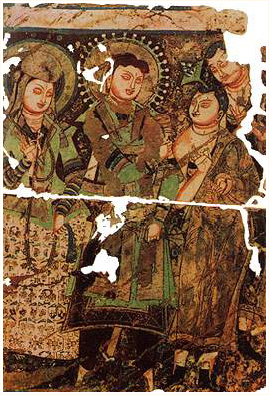
While in Carthage, he joined a self styled ‘Christian’ group following the Mesopotamian prophet Mani. He became an ‘auditor’ (listener or hearer) of the Manicheans. Manichaeism answered the question of the existence of evil by proposing a radical dualism between the realm of light, or God and the realm of darkness or Satan. Adam was the product of the mating of a male and female demon, as was Eve. The first human parents are not the creation of God but resulted from evil’s initiative. Light was trapped in the visible world. God counters this tactic by sending Jesus from the light realm to reveal divine knowledge (gnosis) to Adam and Eve. For the Manicheans Jesus was not the same as the orthodox Christianity, since human flesh in their view has evil origins and comes about through procreation which emulates the demonic origin of Adam and Eve[vi].

Augustine’s conversion takes place after he succeeds to the Chair of Rhetoric in Milan in 383. Here he meets Bishop Ambrose who is an eloquent speaker and who defends the Old Testament against the criticisms of Manicheans. St. Augustine’s main difficulty with the Bible (aside from the poor Latin style of his translation) was the lack of agreement between the genealogies of Christ in Gospels of Matthew and Luke. Looking back he writes;

“I am speaking to you as one who was myself caught out once upon a time, when as a lad I wanted to tackle the divine Scriptures with techniques of clever disputation before bringing to them the spirit of earnest inquiry. In this way I was shutting the door of my Lord against myself by my misplaced attitude; I should have been knocking at it for it to be opened, but instead I was adding my weight to keep it shut.”[vii]

Again looking back in his work The Usefulness of Belief (AD 391), Augustine writes,

“But there is nothing more rash—and rashness as a boy I had plenty—than to desert the professed expositors of books which they possess and hand on to their disciples, and instead to go asking the opinion of others who, for no reason I can think of, have declared most bitter war against the authors of these books.”[viii]

Under the teaching of the Manicheans Augustine had come to profess “despair” which led him to believe that the Old Testament was filled with difficulties that could not be resolved (Conf. V.14.24).

Text © Scott McKellar 2011


[i] St Augustine follows the ages of man according to the ancient world: infantia, puerita, adulescens, and iuventus. Frederick Van Fleteren, “Confessions” in Augustine through the Ages: An Encyclopedia, ed. Allan D. Fitzgerald, O.S.A., Grand Rapids, Erdmanns, 1999, p. 229. James J. O’Donnell notes, “To approach that book with the best effect, let us dwell on the Augustine of 397, the forty-two-year-old getting ready to tell his story in the form destined to become famous. For him, “youth” (iuventus) ended at forty-five, to be succeeded by “maturity” (gravitas) and then by “old age” (senectus) at sixty.” O’Donnell, Augustine: A New Biography (New York: Harper 2005) p. 26-27.

[ii] John M. Rist, Augustine, New York: Cambridge University Press, 1994. p. 14.

[iii] Peter Brown, Augustine of Hippo: A Biography, Revised Edition with a New Epilogue, ?

[iv] Unless otherwise noted all quotations from, St. Augustine, Confessions, trans. Maria Boulding, O.S.B., The Works of Saint Augustine for the 21st Century, Ed John Rotelle, O.S.A., New York, New City Press, 1997.

[v]Joseph T. Lienhard , Augustinian Studies Volume 27, Issue 1 – 1996, p. 9).

[vi] J. Kevin Coyle, “Mani, Manicheism,” in Augustine through the Ages: An Encyclopedia, ed. Allan D. Fitzgerald, O.S.A., Grand Rapids, Eerdmans, 1999, esp. 521-522, cf. Serge Lancel, St. Augustine, trans. Antonia Nevill, London, SCM Press, 2002, p. 31-36.

[vii] St. Augustine, Sermon 51, trans. Edmund Hill, O.P., The Works of Saint Augustine for the 21st Century, Ed. John Rotelle, O.S.A., New York, New City Press, 1997, 51.6.

[viii] St Augustine, De utilitate credendi , vi, 13, trans. Burleigh, p. 301.

Wednesday, January 26, 2011

Feast of the Conversion of St. Paul

Caravaggio-Conversion-of-St-Paul-1601 The doctrine concerning of the universal call to holiness is central to the teachings of Second Vatican council.   I would like to suggest that St. Paul was the most important source for this truth highlighted by Lumen Gentium.

I would like to invite you to journey with St Paul as he explores the theme of the universal call to holiness. For St. Paul, this journey begins on the road to Damascus which St. Luke narrates in Acts 9. Prior to his conversion, Saul is a pious Pharisee. He was probably from the School of Shammai which believed that Israel must be free of the gentile yoke. He tells us in Acts 22; “I am a Jew, born at Tarsus in Cilicia, but brought up in this city at the feet of Gamaliel, educated according to the strict manner of the law of our fathers, being zealous for God as you all are this day” (Acts 22:3). As a zealous Pharisee, he had gone “to the high priest and asked him for letters to the synagogues at Damascus, so that if he found any belonging to the Way, men or women, he might bring them bound to Jerusalem” (Acts 9:1-2). Saul is feeling very righteous as travels to Damascus, so when he experiences “a light from heaven [that] flashed about him” (Acts 9:3) he is expecting a heavenly cheer. He expects to hear, “well done my good and faithful servant.” Saul may have been thinking of the stories from other Rabbinic mystics who had seen visions of the Merkabah or throne of God descending from heaven as the prophet Ezekiel experienced in the Old Testament. Instead what he hears shocked him. He feel to the ground, began to dialogue with a heavenly voice. The voices cries out, “Saul, Saul, why do you persecute me?” To which Saul replies with some confusion, “Who are you, Lord?” And the heavenly voice replies, “I am Jesus, whom you are persecuting; but rise and enter the city, and you will be told what you are to do” (Acts 9:5-6).

We need to think about this, the heavenly voice said, “I am Jesus, whom you are persecuting…” We need to ask, did the Rabbi Saul ever literally persecute Jesus? Had he even met Jesus? As far as we can tell the answer is “No.” He had persecuted Christians, or the followers of the way as they are called in this passage. Here for the first time he learns the central truth about communion in Christ. To persecute the Church is to persecute Jesus. Jesus and the Church are one. After this life changing encounter, Saul the Rabbi becomes Paul the Apostle of Christ Jesus, by the will of God (1 Corinthians 1:1).

I would like to note a small pet peeve about this passage. In Catholic art since the middle ages, St. Paul is always depicted as falling off a horse in this episode. If you search the text carefully you will not find a horse. What you do find, however, is that after St. Paul was blinded the men he was with “led him by the hand and brought him into Damascus” (Acts 9:8). If you have a blind man and a horse, would you lead him by the hand, or put him on the horse and lead the horse instead?

Returning to our main point, St. Paul learns that to persecute the Church is to persecute Jesus. Jesus and the Church are one. From this experience the Apostle Paul gains one of his most characteristic ways of describing all of the faithful as “in Christ Jesus.” The expression “in Christ” or “in Christ Jesus” occurs 164 times in the Pauline corpus. Furthermore, if you investigate this theme, to be “in Christ” is to be “in the Spirit.”

Writing to the Galatians St Paul, notes,

“But now that faith has come, we are no longer under a custodian; 26for in Christ Jesus you are all sons of God, through faith. 27For as many of you as were baptized into Christ have put on Christ” (Galatians 3:26-27)

By virtue of our baptism we have been joined to Christ.. This oneness includes bearing his image, being holy as he is holy.  This is the inescapable vocation of all the faithful.


SGM

Monday, January 10, 2011

The Christian Faith is Rooted in History

baptismmosaic What happened after Jesus commanded the Apostles “Go therefore and make disciples of all nations, baptizing them in the name of the Father and of the Son and the Holy Spirit, teaching them to observe all that I have commanded you”(Mt. 28: 19-20)? How did the Church survive the periodic persecution of the Romans for 300 years as a mostly underground, house church, yet emerging as the Church of the Roman Empire under Constantine? How did she overcome the heresies which threatened to hopelessly divide her? How did she begin to convert the barbarian tribes that overran the Roman Empire and build Christendom anew? How did Christendom emerge into a powerful rivalry between church and state? Is the story of the Church’s development of doctrine, its struggle to develop as an institution, its Saints, a story worth exploring today?

The Christian faith is rooted in history. Central to our faith is the fact that Jesus Christ became man and lived and taught and left us a rich legacy, which his apostles and disciples have since spread to every continent. The Christian announcement of Jesus Christ as Savior and Son of God is the product of faith, but is, nonetheless, based upon history and revelation. How the Church produced the Bible is itself a fascinating story of history, of which many Christians are ignorant. They are unaware that the New Testament canon was not finalized until the end of the fourth century by Church councils. This fact alone has great significance for those trying to understand the Church’s development. Church history also makes clear that the Bible is salvation history, not a mere collection of stories.

The Catholic Church is the oldest institution in the Western world. It has made its mark on history, yet many Christians today see no reason to study it. Myths about the Church abound. Historical study of the Church was and is an important part of how the Church understands herself. Certainly, historical factors played a role in the great debate of the second and third centuries in defining Christ in the face of challenges by the heretical Arians and others who denied his divinity. The great churchmen and councils that decided these issues, beginning with the Council of Nicaea in 325 A.D. which gave us the Nicene Creed, are the very fabric of Church history. The terms “Trinity” and “apostolic succession,” neither of which are found in Scripture, require the study of history for a full understanding. It is only through the study of history that we learn their Christian perspective and meaning.

To study Church history is to see the work of God amidst the strife and turmoil of man’s story. What did Christ mean when he said “the gates of hell” would not prevail against the Church? What significance did the keys he gave to St. Peter have for the Church or the power of binding and loosing? History puts these questions into perspective and helps us to understand our faith better as we see the Church marching through the ages. Her development from a seedling into a great institution is not without blood and tears, but Christians need not change the subject when the Crusades or the Inquisition become the topic of discussion. We don’t defend the extremes of either, but rather note that they were a reflection of their time and culture and there were some meritorious reasons for doing these things. The way that the Holy Spirit reveals truth is gradually over the course of centuries. The Church is growing into the fullness of Christ, and even today we fall short

It has been said that the Church is “the greatest humanizing agent the world has ever seen” and this is demonstrated in history. It was the Church which created the monasteries, which kept alive culture during the so-called “Dark Ages.” Even some secular histories now acknowledge as much. Still the prevalent view is that the rise of science, reason and a more humane approach to human affairs arose in the Enlightenment period of the seventeenth and eighteenth centuries. But according to historian, Thomas Woods in his work, How the Catholic Church Built Western Civilization, this occurred much earlier in the Middle Ages and it was the Church and its institutions, especially monasteries, hospitals, cathedral schools, universities, etc. that laid the foundation for the development of the scientific revolution, of modern international law and human rights, and of modern economic theory. This is not mere triumphalism or misplaced devotion since to give credit where credit is due is only just. Nor is this an attempt to ignore the corruption or abuses that infected the Church and made possible the Protestant Reformation and led to Council of Trent and beginning of a Catholic revival. On the contrary, these too are a part of the fabric of our Church history. Let’s explore them together!

On the Feast of St. William of Bourges,

Dr. Claude Sasso

Study more about Church History with the Bishop Helmsing Institute;

clip_image001

clip_image002

Thursday, January 6, 2011

Saint Polycarp, Bishop of Smyrna and Holy Martyr

Polycarp One of the more famous individuals from the close of the apostolic era was the man tradition remembers as "Saint Polycarp, Bishop of Smyrna and Holy Martyr.” Polycarp was born around 69-70 A.D. According to St. Irenaeus, Polycarp was a disciple of St. John the Apostle and was personally appointed by Apostles as the bishop of the church in Smyrna (modern day Turkey). St. Polycarp was the leading figure among the churches in Asia in the mid second century. The Martyrdom of Polycarp records that Bishop Polycarp served faithfully for eighty-six years (Mart Pol 9.3) before being heroically martyred on February 23, 155.

Because of his long life and direct connection to the Apostles he was an important defender of orthodoxy against such heretics as Marcion and Valentinus. St. Irenaeus recounts that he knew Polycarp from his childhood, and he revered him as a holy saint. Irenaeus notes, “I can even describe the place where the blessed Polycarp used to sit and discourse-his going out, too, and his coming in-his general mode of life and personal appearance, together with the discourses which he delivered to the people; also how he would speak of his familiar intercourse with John, and with the rest of those who had seen the Lord.” He recalls the story of Marcion coming to Polycarp and asking if Polycarp would recognize him. Polycarp replies, “Of course I recognize you, the first born of Satan!” (Adv Haer 3,3,4).

St. Irenaeus relates how St. Polycarp journeyed Rome around 150-155 A.D. A dispute had arisen over the date of Easter between the church in Asia and the Church in the West. Polycarp met with Pope Anicetus. Each bishop felt obliged to follow the traditions they had been handed down. Polycarp felt Easter should be celebrated on the 14th day of the Jewish lunar month of Nisan, while Anicetus on the Sunday after the 14th of Nisan. Polycarp appealed to the practice of St. John and the Apostles, while Anicetus to the custom of his predecessors and to dominical usage. Although the Pope and bishop Polycarp could not achieve common ground in their practice they remained in communion and parted on the best of terms. While there could be no tolerance of the heretical views of Marcion or the early Gnostics, the Church could embrace different liturgical traditions.

St Irenaeus tells us that Bishop Polycarp wrote a number of letters “to neighboring Churches to confirm them, or to certain of the brethren, admonishing and exhorting them.” Unfortunately only St. Polycarp’s letter addressed to the Philippians remains. The theme of the letter is summed up in Polycarp’s exhortation, “‘Therefore prepare for action and serve God in fear’(1 Pet. 1:13; cf. Ps. 2:11) and truth, leaving behind the empty and meaningless talk and the error of the crowd” (Pol Phil 2.1). The letter is a rousing call to live the Christian life fully and consistently in the midst of the confusion and temptations of the world. The letter is filled with quotations from the New Testament and St. Clement’s letter to the Corinthians. One can clearly see the “interwovenness” of Sacred Tradition in his letter. The living interpretive presence of Christ is expressed in the Church through his apostolic ministry. Polycarp notes, “For I am convinced that you are all well trained in the sacred Scriptures” (Pol Phil 12.1). Scripture is the center of the Church’s Tradition and it is made manifest in the preaching, teaching, doctrine and liturgy of the Church.

The Church in Philippi is again battling the heresy of docetism which denies that Jesus came in the flesh. Polycarp complains that these heretics twist “the sayings of the Lord to suit their own sinful desires” (Pol Phil 7.1). Sacred Scripture requires the interpretive presence of the Church. Knowing our faith well also helps us to live our faith in the midst of our daily life. One difficult distraction that Polycarp mentions is greed and the love of money (Pol Phil 2.1; 4.1; 5.2; 6.1; and 11.1). This was apparently the difficulty of a fallen away presbyter of the Church in Philippi named Valens (Pol Phil 11.1-4). Polycarp councils the Philippians to treat Valens kindly in hopes of winning him back from his waywardness.

The ultimate test of a disciple’s faithfulness is martyrdom. Polycarp’s martyrdom is recounted in detail in the Martyrdom of Polycarp (AD 156). This document is a combination of a letter and an act of martyrdom or eyewitness account of martyrdom (Cf. Acts 7, Revelation 6:9-11). The account of Polycarp’s death is the first full account of this type. Suffering death by Martyrdom was considered the ultimate imitation of Christ. The ‘baptism of blood’ of the martyr was considered the equivalent of normal Baptism. Since at least the second century the anniversary of the martyr’s death was celebrated with a feast at the tomb of the martyr and later churches were built over these tombs. The martyrs were venerated as powerful intercessors and their relics were sought after. St. Polycarp’s death is extremely heroic. The witnesses record, “Then the materials prepared for the pyre were placed around him; and as they were also about to nail him, he said: ‘Leave me as I am; for he who enables me to endure the fire will also enable me to remain on the pyre without moving, even without the sense of security which you get from the nails.’” (Mart Pol 12.3). The fire was miraculously unable to kill Polycarp, so his executioner had to stab him with a dagger. His body was later cremated by the soldiers and his friends gather up his bones and began to celebrate the birthday of his martyrdom.

Holy Mary, Queen of Martyrs, pray for us.

SGM

Study more about Church History with the Bishop Helmsing Institute;

clip_image001

clip_image002

Wednesday, January 5, 2011

St. Ignatius of Antioch (Part II)

st-ignatius As mentioned previously, St. Ignatius was condemned to death during the reign of the Emperor Trajan. His writings give us a unique glimpse of the life and beliefs of the Church at the close of the first century. In his writings we are still very close to Christ and his Apostles. Can we see the face of Jesus reflected in his writings?

St. Ignatius, in his letter to the Philadelphians, speaks of the unity we share through our fellowship or communion through the Eucharist. The Eucharist is the focus of the oneness we profess in the creed. It is a sacramental sign of this unity. St. Ignatius writes;

“Take care, therefore, to participate in one Eucharist (for there is one flesh of our Lord Jesus Christ, and one cup which leads to unity through his blood; there is one altar, just as there is one bishop, together with the presbytery and the deacons, my fellow servants), in order that whatever you do, you do in accordance with God” (Ignatius to the Philadelphians 4.1).

Later in his letter to the Smyrnaeans, St Ignatius addresses a problem with the heresy of docetism. Although not a unified movement, the early Christians had to correct the tendency among some early Christians to consider the humanity and sufferings of the earthly Christ as merely apparent rather than real. St. Ignatius links this belief to a very low regard for the Eucharist. He notes;

“They abstain from Eucharist and prayer, because they do not confess that the Eucharist is the flesh of our Savior Jesus Christ who suffered for our sins, which the Father raised up by his goodness. They then who deny the gift of God are perishing in their disputes; but it were better for them to have love, that they also may attain to the Resurrection” (Ignatius to the Smyrnaeans 6.2). Seeing the face of Jesus clearly in the face of the early Church allows one to profess as well our belief in the Real Presence of Christ in the Eucharist. Earlier in his letter to the Ephesians, St. Ignatius refers to the Eucharist as “the medicine of immortality, the antidote we take in order not to die but to live forever in Jesus Christ” (Ignatius to the Ephesians 20.2).

Our unity focuses not just on the Eucharist by also on the Bishop. St. Ignatius writes;

“You must all follow the bishop, as Jesus Christ followed the Father, and follow the presbytery as you would the apostles; respect the deacons as the commandment of God. Let no one do anything that has to do with the church without the bishop. Only that Eucharist which is under the authority of the bishop (or whomever he himself designates) is to be considered valid. (2) Wherever the bishop appears, there let the congregation be; just as wherever Jesus Christ is, there is the Catholic Church. It is not permissible either to baptize or to hold a love feast without the bishop.” (Ignatius to the Smyrnaeans 8.1-2)

This passage highlights the role of the bishop in preserving the unity of the Church. In numerous other passages St. Ignatius emphasizes a divine hierarchy of the bishop, presbyters, and deacons. The Catechism reminds us that the bishop is the “guarantor and servant of the unity, catholicity and apostolicity of his Church” (CCC 1292). The Eucharist is celebrated under the authority or presidency of the bishop. The Catechism notes, “The bishop of the place is always responsible for the Eucharist, even when a priest presides; the bishop's name is mentioned to signify his presidency over the particular Church” (CCC 1369). St. Ignatius observes that only the Eucharist which is under the authority of the bishop is valid. It is not permissible to hold an agape feast without the authority of the bishop.

St. Ignatius is also the first Church Father to use the word ‘catholic.’ Scholars will dispute whether it is appropriate to capitalize the word as ‘Catholic.’ Generally the basic meaning of ‘catholic’ is taken as the universal Church as opposed to the local church. William Schoedel has pointed out that studies of the original Greek word for ‘catholic’ make it unlikely that it refers to geographic extension, or universal as opposed to local. In the context of St. Ignatius the meaning of ‘catholic’ is more likely a reference to an organic unity under the bishop which parallels the universal church is an organic unity under Christ. Schoedel observes, “Thus we may say that the ‘catholic’ church here is not the universal church opposed to heresy, but the whole church resistant by its very nature to division.” Later the unity of the Church reflected in the whole allowed the Church to call herself ‘Catholic’ in the sense of the fullness of unity in distinction to heresy and in her mission for geographic extension to the whole world (Matthew 28:18-20). The Catechism notes that “the word ‘catholic’ means ‘universal,’ in the sense of ‘according to the totality’ or ‘in keeping with the whole.’ There is a double sense in which the Church is ‘catholic’. The Church is ‘catholic’ because Christ is present in her (giving her correct and complete confession of faith, full sacramental life, and ordained ministry in apostolic succession) and secondly because “she has been sent out by Christ on a mission to the whole of the human race” (CCC 830-831).

We can see the face of Jesus in the community reflected in the letters of St. Ignatius. As Pope Benedict has recently noted, “In Christ, charity and truth becomes the Face of his Person, a vocation for us to love our brothers and sisters in the truth of his plan” (Caritas in Veritate, 1). Just as St. Ignatius answered those who thought Jesus only seemed to be flesh, today we must constantly dialogue with a dictatorship of untruth and the mere appearance of human opinion rather than a truth based in the person of Christ. Holy Mary, Seat of Wisdom, Pray for us.


SGM

Study more about Church History with the Bishop Helmsing Institute;

clip_image001

clip_image002

Tuesday, January 4, 2011

St. Ignatius, Bishop of Antioch

St_Ignatius_of_Antioch The Fourth century church historian Eusebius tells us that St. Ignatius, Bishop of Antioch was condemned to die in Rome by becoming “food for wild beasts on account of his testimony to Christ” (Ecc. Hist 3, 36). St. Ignatius was condemned during the reign of the Emperor Trajan (107 A.D.). He was transported “under the strictest military surveillance” which he recounts as “being bound amidst ten leopards that is, a company of soldiers who only become worse when they are well treated.” Ignatius was taken as far as Smyrna where he was greeted by Polycarp the local bishop. From Smyrna Ignatius writes letters to four local churches. He writes to Ephesus, the capital of the Roman province of Asia (modern day Turkey), and to the neighboring cities of Magnesia, Tralles and Rome. Ignatius is then taken to Troas in the north-west corner of Asia. From Troas he wrote letters to the Philadelphians, to the Smyrnaeans and to Bishop Polycarp.

I would like to begin this reflection by focusing on Ignatius’ letter to the Ephesians. In this letter he highlights the role of the bishop as a source of unity in the Church. He writes,

“Thus it is proper for you to act together in harmony with the mind of the bishop, as you are in fact doing. For your presbytery, which is worthy of its name and worthy of God, is attuned to the bishop as strings to a lyre. Therefore in your unanimity and harmonious love Jesus Christ is sung.” (Ignatius to the Ephesians 4:1). Later he adds a warning to those who might attempt to act without a bishop, “Let no one be misled: if anyone is not within the sanctuary, he lacks the bread of God. . . Therefore whoever does not meet with the congregation thereby demonstrates his arrogance and has separated himself . . .  Let us, therefore, be careful not to oppose the bishop, in order that we may be obedient to God. (Ignatius to the Ephesians 5:1-3).

In his letter to the Ephesians, St. Ignatius addresses the intriguing question of why Jesus allowed himself to be baptized by John the Baptist?”  Recently Pope Benedict XVI has reflected on this question in his work Jesus of Nazareth. He observes,

“Baptism itself was a confession of sins and the attempt to put off an old, failed life and to receive a new one. Is that something Jesus could do? How could he confess sins? How could he separate himself from his previous life in order to start a new one?” (p. 16-17).

The answer on one level is that Jesus did this to “fulfill all righteousness” (Matthew 3:15). Pope Benedict notes, “Righteousness is man’s answer to the Torah, acceptance of the whole of God’s will, the bearing of the “yoke of God’s Kingdom.” (Jesus, p. 17). St. Ignatius addresses this question by recounting a primitive confession of the Church, “For our God, Jesus the Christ, was conceived by Mary according to God’s plan, both from the seed of David and of the Holy Spirit. He was born and was baptized in order that by his suffering he might cleanse the water” (Ignatius to the Ephesians 18:2). St. Ignatius affirms that Jesus was baptized in order to “cleanse the water.”

In the Eastern Church the Feast of Epiphany is Jesus day of Baptism. Eastern iconography depicts the waters of Jesus’ Baptism as a liquid tomb leading down to Hades. There is a close connection between Jesus Baptism and Easter. St. John Chrysostom writes, “Going down into the water and emerging again are the image of the descent into hell and the Resurrection.” Jesus’ Baptism purifies the waters of Baptism and joins them to the entire mystery of salvation. Pope Benedict notes, “The sacrament of Baptism appears as the gift of participation in Jesus world-transforming struggle in the conversion of life that took place in his descent and ascent” (Jesus, p. 21). As St. Paul, notes, “But now that faith has come, we are no longer under a custodian; for in Christ Jesus you are all sons of God, through faith. For as many of you as were baptized into Christ have put on Christ” (Galatians 3:26-27). It is through baptism that we are brought into communion with Christ, and so into communion with his suffering, death and Resurrection. Earlier St. Ignatius describes the mystery of Christ’s person in another early creed, “There is only one physician, who is both flesh and spirit, born and unborn, God in man, true life in death, both from Mary and from God, first subject to suffering and then beyond it, Jesus Christ our Lord” (Ignatius to the Ephesians 7.2). It is only through the mystery of Christ who is “flesh and spirit, born and unborn, God in man” that the waters of Baptism become a life giving means of grace and the foundational Sacrament of initiation. Flowing out of this baptismal union with Christ is a universal vocation to holiness and apostolic witness. The Christian life becomes an active participation in the life of Christ and a light to the world in which we live. Holy Mary, Star of the New Evangelization, pray for us. (Novo Millennio Ineunte 74).

SGM

Study more about Church History with the Bishop Helmsing Institute;

clip_image001

clip_image002

Wednesday, December 22, 2010

Matthew’s Divorce “Exception Clause”

smallsign In today’s world we experience daily the tragedy of divorce and its effects on the family and our culture. With a few rare exceptions among various small Christian communities, the Catholic Church is the only church which refuses to accept divorce under any circumstances. The Catechism reminds us;

The Lord Jesus insisted on the original intention of the Creator who willed that marriage be indissoluble.174 He abrogates the accommodations that had slipped into the old Law.175

Between the baptized, "a ratified and consummated marriage cannot be dissolved by any human power or for any reason other than death."176 (CCC 2382)

Particularly in some Protestant groups, the apparent “exception clause” given by Jesus in Matthew 19:9 is cited as justification for divorce and the freedom to remarry; “And I say to you: ‘whoever divorces his wife, except for unchastity, and marries another, commits adultery; and he who marries a divorced woman, commits adultery’” (RSV-CE). The Catholic NAB Bible translates this, “I say to you, whoever divorces his wife (unless the marriage is unlawful) and marries another commits adultery” (NAB). What is Jesus saying here? Is he intending to allow an ‘exception’ allowing divorce?

First we need to examine the context of these verses. In this gospel narrative the Pharisees approach Jesus with a question to “test” him. “And Pharisees came up to him and tested him by asking, ‘Is it lawful to divorce one’s wife for any cause?’” (RSV-CE Mt 19:3; cf. Mk 10:2)

There were two main Pharisaic schools at the time of Jesus and they differed in their interpretation of the Mosaic Law on divorce as found in Deut 24:1-4:

“When a man takes a wife and marries her, if she then finds no favor in his eyes because he has found some indecency in her, and he writes her a bill of divorce and puts it in her hand and sends her out of his house, and she departs out of his house, and if she goes and become another man’s wife . . . then the former husband, who sent her away, may not take her again to be his wife . . .”

Rabbinic interpretations apparently turned on the ambiguous phrase in Deut 24:1 translated “some indecency.” The Hillel school interpreted “indecency” so loosely that a man could put his wife away for virtually any reason, even for burning his dinner. The school of Shammai interpreted the verse much more strictly--limiting the legitimate reasons for divorce to sexual impurity on the part of the wife.

Responding to this dilemma Jesus answered; ‘Have you not read that he who made them from the beginning made them male and female, and said, “For this reason a man shall leave his father and mother and be joined to his wife and the two shall become one”? So they are no longer two, but one. What therefore God has joined together, let no man put asunder.’” (Mt 19:4-6; cf. Mk 10:6-9)

Jesus does not agree with either ‘school’ of interpretation but directs the discussion back to the fundamental nature of the human person created in the ‘image of God’ “in the beginning.” God’s original intensions in creating man and woman in the image and likeness of God—as a human family are ‘normative’ for our understanding of marriage. From this foundation Jesus draws the decisive conclusion, “what God has joined let no man put asunder.” Pope John Paul II states, “In the light of these words of Christ, Genesis 2:24 sets forth the principle of the unity and indissolubility of marriage as the very content of the Word of God, expressed in the most ancient revelation.”

Following in the footsteps of Christ, the Church understands marriage as indissoluble. The Church interprets Christ’s words as upholding “the original intention of the Creator who willed that marriage be indissoluble” and as abrogating the accommodations that had slipped into the old Law” (CCC 2382). Such accommodations would include those suggested by the Pharisees which parallel modern views of many Christian communities.

What then do we make of the apparent exception clause? “And I say to you: ‘whoever divorces his wife, except for unchastity, and marries another, commits adultery; and he who marries a divorced woman, commits adultery’” (Mt 19:9).

The Greek word translated as “unchastity” in the RSV is porneia. There are three possible meanings of porneia.

1. “fornication (or perhaps better sexual impropriety of any kind hence “unchastity”)

2. incest

3. adultery

The NAB Bible translates Matthew 19:9, “I say to you, whoever divorces his wife (unless the marriage is unlawful) and marries another commits adultery.” In translating “(unless the marriage is unlawful)” the text of the NAB is interpreting the word porneia along the lines incest. Gentile marriages in the first century Palestine did not necessarily follow the strict Jewish laws regarding the prohibition of marriage to a relative which would be considered invalid or unlawful under Jewish law.

It is also possible that what was in mind is the discovery of unfaithfulness or ‘unchastity’ during the protracted betrothal or engagement. We must remember that the first century customs for marriage were quite different than our own. The English words ‘engaged’ and ‘betrothed’ do not convey the same meaning today as they would have in the New Testament. Joseph was ‘betrothed’ to Mary, and when he mistakenly suspected unfaithfulness on her part when she was discovered to be with child, “he decided to divorce her quietly” (Matt 1:19). Divorce was necessary to break off the betrothal. The couple was already considered married after the betrothal but typically waited a year before completing the marriage by consummating their relationship.

In both of these cases we are dealing with an unlawful or incomplete marriages which are not exceptions to the divorce rule but circumstances under which the marriage may in fact not have taken place lawfully or completely. A judgment by the Church that a marriage has not occurred is called an annulment.

To me its seems most likely that Jesus had in mind the idea of unchastity referring to the pre-marital engagement period during which in Jewish custom the couple are actually married but have not yet consummated the marriage. Under these circumstances and before consummation occurred if one of the couple was found to have committed “unchastity” then divorce is possible since no real marriage had taken place. A valid marriage requires both an exchange of consent and consummation with a human act that is open to life.

Although the Greek porneia has also been translated as “adultery” (or “fornication” which is sometimes interpreted as adultery), it is important to realize that there is a distinct Greek word for “adultery,” moicheia, used twice in that same verse. Note the verse with the Greek words shown; “And I say to you: ‘whoever divorces his wife, except for porneia, and marries another, commits moicheia; and he who marries a divorced woman, commits moicheia’” (Mt 19:9). If we translate porneia as ‘adultery’ Jesus would appear to be saying something odd, “whoever divorces his wife, except for adultery, and marries another, commits adultery.” Why would adultery break the bounds of an indissoluble marriage such that you can freely remarry without committing adultery?

It should also be pointed out that Christian tradition records Jesus as unequivocally opposed to divorce. Neither Luke nor Mark records any exception;

“Every one who divorces his wife and marries another commits adultery, and he who marries a woman divorced from her husband commits adultery” (Luke 16:18).

“Whoever divorces his wife and marries another, commits adultery against her; and if she divorces her husband and marries another, she commits adultery” (Mk 10:11-12).

The liberal attitude towards divorce and remarriage we see today is a very modern conception in Christian tradition. Against this view, the Church has consistently urged us to recognize marriage as indissoluble and that a marriage between a baptized man and woman which has been ratified and consummated “cannot be dissolved by any human power or for any reason other than death” (CCC 2382).

Wednesday the Fourth Week of Advent,

SGM

Matthew’s Divorce “Exception Clause”

smallsign In today’s world we experience daily the tragedy of divorce and its effects on the family and our culture. With a few rare exceptions among various small Christian communities, the Catholic Church is the only church which refuses to accept divorce under any circumstances. The Catechism reminds us;

The Lord Jesus insisted on the original intention of the Creator who willed that marriage be indissoluble.174 He abrogates the accommodations that had slipped into the old Law.175

Between the baptized, "a ratified and consummated marriage cannot be dissolved by any human power or for any reason other than death."176 (CCC 2382)

Particularly in some Protestant groups, the apparent “exception clause” given by Jesus in Matthew 19:9 is cited as justification for divorce and the freedom to remarry; “And I say to you: ‘whoever divorces his wife, except for unchastity, and marries another, commits adultery; and he who marries a divorced woman, commits adultery’” (RSV-CE). The Catholic NAB Bible translates this, “I say to you, whoever divorces his wife (unless the marriage is unlawful) and marries another commits adultery” (NAB). What is Jesus saying here? Is he intending to allow an ‘exception’ allowing divorce?

First we need to examine the context of these verses. In this gospel narrative the Pharisees approach Jesus with a question to “test” him. “And Pharisees came up to him and tested him by asking, ‘Is it lawful to divorce one’s wife for any cause?’” (RSV-CE Mt 19:3; cf. Mk 10:2)

There were two main Pharisaic schools at the time of Jesus and they differed in their interpretation of the Mosaic Law on divorce as found in Deut 24:1-4:

“When a man takes a wife and marries her, if she then finds no favor in his eyes because he has found some indecency in her, and he writes her a bill of divorce and puts it in her hand and sends her out of his house, and she departs out of his house, and if she goes and become another man’s wife . . . then the former husband, who sent her away, may not take her again to be his wife . . .”

Rabbinic interpretations apparently turned on the ambiguous phrase in Deut 24:1 translated “some indecency.” The Hillel school interpreted “indecency” so loosely that a man could put his wife away for virtually any reason, even for burning his dinner. The school of Shammai interpreted the verse much more strictly--limiting the legitimate reasons for divorce to sexual impurity on the part of the wife.

Responding to this dilemma Jesus answered; ‘Have you not read that he who made them from the beginning made them male and female, and said, “For this reason a man shall leave his father and mother and be joined to his wife and the two shall become one”? So they are no longer two, but one. What therefore God has joined together, let no man put asunder.’” (Mt 19:4-6; cf. Mk 10:6-9)

Jesus does not agree with either ‘school’ of interpretation but directs the discussion back to the fundamental nature of the human person created in the ‘image of God’ “in the beginning.” God’s original intension in creating man and woman in the image and likeness of God are ‘normative’ for our understanding of marriage. From this foundation Jesus draws the decisive conclusion, “what God has joined let no man put asunder.” Pope John Paul II states, “In the light of these words of Christ, Genesis 2:24 sets forth the principle of the unity and indissolubility of marriage as the very content of the Word of God, expressed in the most ancient revelation.”

Following in the footsteps of Christ, the Church understands marriage as indissoluble. The Church interprets Christ’s words as upholding “the original intention of the Creator who willed that marriage be indissoluble” and as abrogating the accommodations that had slipped into the old Law” (CCC 2382). Such accommodations would include those suggested by the Pharisees which parallel modern views of many Christian communities.

What then do we make of the apparent exception clause? “And I say to you: ‘whoever divorces his wife, except for unchastity, and marries another, commits adultery; and he who marries a divorced woman, commits adultery’” (Mt 19:9).

The Greek word translated as “unchastity” in the RSV is porneia. There are three possible meanings of porneia.

1. “fornication (or perhaps better sexual impropriety of any kind hence “unchastity”)

2. incest

3. adultery

The NAB Bible translates Matthew 19:9, “I say to you, whoever divorces his wife (unless the marriage is unlawful) and marries another commits adultery.” In translating “(unless the marriage is unlawful)” the text of the NAB is interpreting the word porneia along the lines incest. Gentile marriages in the first century Palestine did not necessarily follow the strict Jewish laws regarding the prohibition of marriage to a relative which would be considered invalid or unlawful under Jewish law.

It is also possible that what was in mind is the discovery of unfaithfulness or ‘unchastity’ during the protracted betrothal or engagement. We must remember that the first century customs for marriage were quite different than our own. The English words ‘engaged’ and ‘betrothed’ do not convey the same meaning today as they would have in the New Testament. Joseph was ‘betrothed’ to Mary, and when he mistakenly suspected unfaithfulness on her part when she was discovered to be with child, “he decided to divorce her quietly” (Matt 1:19). Divorce was necessary to break off the betrothal. The couple was already considered married after the betrothal but typically waited a year before completing the marriage by consummating their relationship.

In both of these cases we are dealing with an unlawful or incomplete marriages which are not exceptions to the divorce rule but circumstances under which the marriage may in fact not have taken place lawfully or completely. A judgment by the Church that a marriage has not occurred is called an annulment.

To me its seems most likely that Jesus had in mind the idea of unchastity referring to the pre-marital engagement period during which in Jewish custom the couple are actually married but have not yet consummated the marriage. Under these circumstances and before consummation occurred if one of the couple was found to have committed “unchastity” then divorce is possible since no real marriage had taken place. A valid marriage requires both an exchange of consent and consummation with a human act that is open to life.

Although the Greek porneia has also been translated as “adultery” (or “fornication” which is sometimes interpreted as adultery), it is important to realize that there is a distinct Greek word for “adultery,” moicheia, used twice in that same verse. Note the verse with the Greek words shown; “And I say to you: ‘whoever divorces his wife, except for porneia, and marries another, commits moicheia; and he who marries a divorced woman, commits moicheia’” (Mt 19:9). If we translate porneia as ‘adultery’ Jesus would appear to be saying something odd, “whoever divorces his wife, except for adultery, and marries another, commits adultery.” Why would adultery break the bounds of an indissoluble marriage such that you can freely remarry without committing adultery?

It should also be pointed out that Christian tradition records Jesus as unequivocally opposed to divorce. Neither Luke nor Mark records any exception;

“Every one who divorces his wife and marries another commits adultery, and he who marries a woman divorced from her husband commits adultery” (Luke 16:18).

“Whoever divorces his wife and marries another, commits adultery against her; and if she divorces her husband and marries another, she commits adultery” (Mk 10:11-12).

The liberal attitude towards divorce and remarriage we see today is a very modern conception in Christian tradition. Against this view, the Church has consistently urged us to recognize marriage as indissoluble and that a marriage between a baptized man and woman which has been ratified and consummated “cannot be dissolved by any human power or for any reason other than death” (CCC 2382).

Tuesday, December 21, 2010

Early Church Leadership in The Didache

women Writing before he became Pope, Cardinal Ratzinger noted that “the light of Jesus is reflected in the saints and shines out again from them” (The Yes of Jesus Christ). He notes, “God’s speaking to us reaches us through men and women who have listened to God and come into contact with God” (The Yes of Jesus Christ). As we continue to reflect on the message of the Didache we seek to find the face of Christ reflected there.

In chapter eleven of the Didache we are introduced to itinerate or travelling ‘apostles’ and ‘prophets’ who are to be shown hospitality and respected but who are not to ask for money for themselves or to ‘out stay’ their welcome. We read, “Now concerning the apostles and prophets, deal with them as follows in accordance with the rule of the gospel” (Didache 11:3). The pattern St. Paul established for his own ministry was to earn his own wages. The travelling apostles described here are the equivalent of missionaries and church planters rather than the original circle of the Twelve plus Paul.

Hospitality was to be shown to all travelers provided they were willing to work. “Everyone ‘who comes in the name of the Lord’ is to be welcomed” (Didache 12:1). The visitor, “if he wishes to settle among you and is a craftsman, let him work for his living” (Didache 12:3). Provision should even be made for those who need further assistance, we are told, “But if he is not a craftsman, decide according to your own judgment how he shall live among you as a Christian, yet without being idle” (Didache 12:4). This matches the advice of St. Paul, “For even when we were with you, we gave you this command: If anyone will not work, let him not eat” (2 Thessalonians 3:10). The kindness shown to these itinerate peoples recognizes their inherent dignity as persons and is mirrored in the modern the advice given in the Compendium of Social Doctrine, which notes that,

“Regulating immigration according to criteria of equity and balance is one of the indispensable conditions for ensuring that immigrants are integrated into society with the guarantees required by recognition of their human dignity. Immigrants are to be received as persons and helped, together with their families, to become a part of societal life” (CSDC 298).

The Didache moves on to discuss the phenomena of prophets who were active in leadership of the Church. Prophets who have been tested and approved and who wish to settle in the community are to be treated with special dignity. They are to receiving the “first fruits” of the wine, oil, money and clothing. We are told, “Take, therefore, all the firstfruits of the produce of the wine press and threshing floor, and of the cattle and sheep, and give these firstfruits to the prophets, for they are your high priests” (Didache 13:3). There role as ‘priests’ even relates to the Eucharist. In the long section relating prayers for the Eucharist we are told, “But permit the prophets to give thanks however they wish” (Didache 12:7).

The Church structure found in the Didache is still very primitive and in the process of developing into its mature form. “Therefore appoint for yourselves bishops and deacons worthy of the Lord, men who are humble and not avaricious and true and approved, for they too carry out for you the ministry of the prophets and teachers. You must not, therefore, despise them, for they are your honored men, along with the prophets and teachers” (Didache 15:1-2). It is likely that at this early stage the titles ‘bishop’ and ‘presbyter’ were not distinguished (cf. Titus 1:5-9). Initially an Apostle, or his delegated coworkers in the apostolic circle (Timothy, Silas, Titus, Barnabas), were the leaders of Churches. Later a transition occurs with a single bishop in each community replacing the Apostles, and being assisted by presbyters. The strong involvement of prophets may have been an unusual element.

The phenomenon of Christian prophecy was still quite common in the early second century. St. Ignatius the Bishop of Antioch recounts his own prophecy in his letter to the Philadelphians, “I called out when I was with you, I was speaking with a loud voice, God’s voice: “Pay attention to the bishop and to the presbytery and deacons. . . . the Spirit itself was preaching, saying these words: “Do nothing without the bishop. . . . .” (Ign. Philadelphians 7:1-2). Ignatius encourages Polycarp to pray for the same gift, “but ask, in order that the unseen things may be revealed to you, that you may be lacking in nothing and abound in every spiritual gift” (Polycarp 2:2). Polycrates, the Bishop of Ephesus, describes the three prophetic daughters of the Apostle Philip “who lived in the Holy Spirit” at Ephesus and he describes Bishop Melito of Sardis (d. 190 A.D.) as “the Eunuch who lived altogether in the Holy Spirit” (Hist. Eccl. 5.24). The writer of the Shepherd of Hermas describes the experience prophecy (Herm Man. 11.9) as does Justin Martyr in his Dialogue with Trypho (39.1; 82.1; 88.1). The phenomena of prophecy also created difficulties for the early Church. The heretic Montanus and his prophets Maximilla and Pricilla claimed to receive a “new prophecy” which predicted the imminent end the world. The Montanists formed their own churches and eventually thought of their “new prophecy” as having greater value that Sacred Scripture. The Church rejected the Montanists as false prophets. At the same time the Church continued to recognize the role of genuine Christian prophecy. Although the Church gained more caution, St. Irenaeus of Lyon (190 A.D.) continued to describe prophetic phenomena in his churches at the close of the second century.

As we reflect on the gift of prophecy in the early Church, may we fan into flames the gift of the Spirit we have received through our Baptism, in order that we to might better reflect the face of Jesus, lighting up the pathways of this earth with faith and love.

Tuesday the Fourth Week of Advent,

SGM

To learn more about Church History click the link below,

clip_image001


clip_image002